“Then their eyes were opened and they knew Him.” (a reflection on the Artos bread)

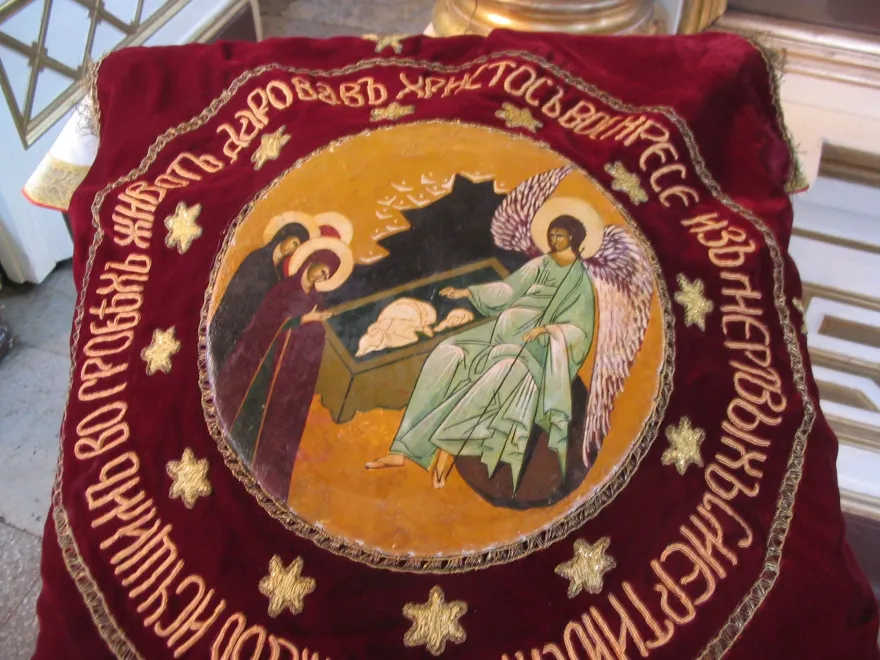
One of the elements that is part of our Paschal celebration, is the Artos, a large round loaf of bread, with an icon of the Resurrection, either stamped on it or placed beside it. The Artos is positioned on the Ambon in front of the Iconostas, for the Paschal vigil and liturgy and by tradition, remains there throughout the rest of the week (it moves in front of the open Royal Doors when services are not being conducted). Indeed there is something special about the Artos given its specific placement, and this is further emphasised by the specific prayers blessing this bread following the service. 

There are in fact two prayers. One prayer is said on the feast of Pascha, and the second on Bright Saturday (although it is generally deferred to Sunday). In the first prayer, a connection is made between the exodus of Israel and the Lord’s Resurrection. The commandment to slay a lamb for Israel’s exodus from Egypt – the Lord’s liberation of His people—prefigures the Lord’s sacrifice, “the Lamb of God” (Jn.1:29) who willingly was slain upon the Cross, taking away the sins of the world, and providing our release from the enemy’s eternal slavery and hell’s indissoluble bonds.  There is also a connection between the kissing and tasting of this bread, and our participation in this heavenly blessing, from He who is the “Fountain of blessings, and the Bestower of healings.” The second prayer expresses the foundational principles that Jesus Christ is not only the “Bread of eternal life” (Jn. 6:35), but also the source of superabundant mercy and nourishment. As He blessed those five loaves in the wilderness and fed the five thousand (Mt. 14:13-21), we pray that the Lord would bless this bread granting bodily and spiritual blessings and health to those who partake of it in faith. 

Given this, the question arises: What makes this bread any different from the Eucharist, let alone the blessed bread offered after a Litya/Artoklasia or memorial, or even the Antidoron (bread offered after the Liturgy)? Furthermore, what makes this bread so different that it is specifically prayed over on Pascha, and then offered to the faithful on the following Saturday or Sunday?

Well first off, this bread is not communion. In the Eucharist, the bread (and wine)  is offered, and is mystically changed (Gk. μεταβολή, Metabole ) to become the Body of Christ in the form of bread (St. Cyril of Jerusalem Catechetical Lecture 22.3); the Artos at Pascha is bread, that is blessed (Gk. Εὐλογημένος, Eulogemenos) to be just that, blessed bread. Secondly, what differentiates Artos from those other blessed breads is that they aren’t necessarily connected to any feast, or event, and can be offered throughout the year. Whereas Artos is prayed over, sprinkled/splashed with holy water, and offered on the feast of feasts – the day without end (thus the full week on the Ambon) – its very context is Pascha, and for good reason. 

In the same way that the disciples Luke and Cleopas  had thier eyes open when their companion  (the risen Lord – Lk. 24:30-31), blessed and broke bread;  we too, are compelled to open the eyes of our hearts, in the blessing and breaking of this Artos bread, and realize the reality of the Resurrection and the abiding presence of the risen Lord, who has journeyed with us, is journeying with us, and will journey with us through life.

Following the Liturgy the Artos will be cut up and distributed to the faithful. Various customs exist regarding the handling of the Artos. Some families cut it further into smaller pieces, let the particles dry, and keep them in their family Icon corner (or in the freezer). Just like our storage and use of the blessed water from Theophany, the Artos should be piously eaten when one is sick or unable to attend Church. Alternatively, there are some that eat the Artos immediately. 

Whatever the customs surrounding the Artos we might observe, we are compelled to reference its context –  the Resurrection. This was beautifully explained by an older friend of mine, who would say that any time she ate the Artos, she would say a prayer of thanksgiving, cross herself, consume the tiny bit of dried bread, and then sing “Christ is Risen,” regardless of the time of year. 

Sermon for the 3rd Wednesday of Great Lent (Genesis 7:6-9).

As we have moved through the readings of Great Lent, we started with the creation stories. We learned about the unique calling that we were given as human beings, who are the bridge between heaven and earth. However, almost immediately after this, we heard how humanity fell and hides from God, and is ultimately expelled from Eden.   Shortly after that we see Cain slaying his brother and moving to Nod. In the Septuagint, it reads that Nod is opposite Eden. This is not to mean, next door to Eden, but it is better thought of as opposed, or the opposite of Eden.

St Clement of Alexandria points out that Nod means “disturbance,” Eden, “the good life.” What can be a more pointed word-picture than opposite Eden? But here is where humanity finds itself. Opposite Eden in every way. We find ourselves in patterns of disturbance, if that isn’t an oxymoron. Everything in our lives is marked by disorder. And right on its heals comes death. 

Death, death and more death. We read about the death of Adams descendants in Genesis 5. The culmination of the story of each of his descendants is that they die. “And he died”, except for Enoch who, “walked with God”. 

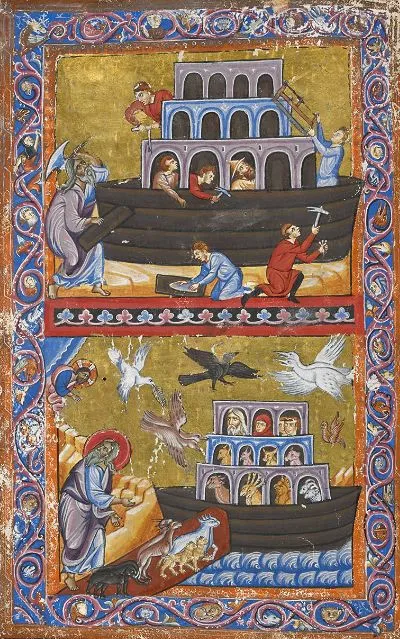
And at the end of the story of Adam’s descendants who all die, we heard the story of a world that is truly opposite Eden. “Then the Lord God saw man’s wickedness, that it was great in the earth, and every intent of the thoughts within his heart was only evil continually (6:5).” Today’s reading is strangely a few short verses of a larger passage that was prescribed for yesterday’s reading. It sort of hyper-focuses on the entrance into the ark.

Noah was six hundred years old when the floodwaters were on the earth. So Noah, with his sons, his wife, and his sons’ wives, went into the ark because of the waters of the flood. Of clean animals, of animals that are unclean, of birds, and of everything that creeps on the earth, two by two they went into the ark to Noah, male and female, as God had commanded Noah. 

Noah and his family are entering the ark that will save them from the floodwaters that are about to come. This is a story that gets told and retold throughout the pages of Scripture in various forms. God will preserve a faithful remnant. What is remnant? For those who sew, or for a carpenter, the remnant is something left-over. It is a piece of cloth or a chunk of wood that is too small to be useful. You might just throw it in the garbage or into the fire because you have no use for it.

 Another example of this story is seen in today’s reading from Isaiah chapter 10. Isaiah is lamenting that Israel has become disobedient to God. They disregard the poor and the needy. They take advantage of the orphan and the widow and God is about to bring judgement on them by allowing them to be invaded by the Assyrians and carried off so that only a remnant will be left. Though their numbers were as the sands of the sea, a remnant was going to be left which was such a small number that even a child could count them. 

This story of the remnant that is protected by God, is told by St Paul in Romans, who identifies us as the remnant, grafted into Israel. The fathers also tell the same story. And it is the story told in the Apacolypse of John.

Indeed, this story (these stories) are about us when we are ruled by our passions. This is where we find ourselves, a remnant, opposite Eden. But God doesn’t throw the remnant into the fire. Instead, this remnant is the very thing He is going to build his project with or sew his garment with. God promises to nurture and protect his remnant, just as He did in the days of Noah.

So what does this mean for us? 

When we find ourselves, “by the waters of Babylon,” when we find ourselves “opposite Eden” what are we to do? Well, the answer is at the same time both simple and yet exceedingly hard. Because another aspect we see in the remnant in Scripture is that what is required of them is faithfulness to God. Noah was obedient to God in building an ark when no one had ever seen rain on the earth. The prophets likewise tell us that, “The remnant of Israel shall not do iniquity, nor speak lies; neither shall a deceitful tongue be found in their mouth (Zep 3:13).” And St John, in his Revelation tells us that the remnant are those who keep the commandments of God. 

Likewise, our participation as members of the remnant is to be faithful and obedient to the commands of the Christ. His first command is to repent. We are offered this season to repent; will we take up that offer? In Matthew 25 on the Sunday of Last Judgement we heard other commandments: feed the hungry, cloth the naked, give the food and water to those who hunger and thirst, visit those in sick or in prison. Will we follow these commands or will we be distracted, yet again, by our passions?

Through the prayers of his holy prophets and the evangelists who show us the way to live, may we learn obedience to the commandments of Christ. 

March 11th 2026

Dn. John Schantz

Getting married. Something better than “the best day of their life” (another reflection on marriage)

Weddings are truly amazing and life changing events that define our lives forever – and for good reason. Indeed in a wedding a man and woman start their new life together, that in many ways reconciles so many of the challenges that confront them. Any differences are put aside, sorrows are consoled and the mundane routines of life give way to extraordinary events. It is no wonder that so many have the expectation that their wedding day is “the best day of their life”, and for good reason, as it is a celebration of a dynamic and transformative love!

The challenge that snares so many newly married couples (and married couples) is when that celebration of love that was their wedding day, is seen simply as a past event; isolated, and insulated from the present and future. In short there is a temptation to see their wedding as being just a moment in time, or a unique experience never to be repeated. For many people, the “best day of their life” is tragically just that; a day (albeit a special one).  

Once the party is over, the guests have gone home, and the wedding gown has been put in a protective garment bag; all those things that were reconciled in their wedding return. Differences again challenge their relationship, those sorrows return to weigh them down, and life returns to a mundane cycle of activities. Alas, this is the reason we still have so many divorces; and even more tragically, why so many men and women avoid getting married altogether. And who could blame them? Indeed if the expectation is that their wedding is going to be “the best day of their life”, then it stands to reason that nothing really will ever be better than that – or – that after the wedding, it is all downhill. 

Of course one only has to look at those who have been happily married for decades, to see that there is a different articulation of this expectation. Without taking anything away from the wonder that is one’s wedding day; understanding it as being “the best day to start their life,”is a context that recognises that  “the best day of their life” is the starting point for that shared dynamic and transformative love, to grow into even better days throughout their marriage!  I think this is one reason that the Lord’s first miracle was manifested at a wedding (Jn. 2:1-11). 

14th century Fresco of the Miracle at Cana, from the Visoki Dečani monastery, Serbia.

As we all know, at the wedding feast in Cana, when the wine ran out, the Lord was asked to do something by his beloved mother, to which He did, in spectacular fashion! At His instruction the servants of the wedding party filled six stone jars with water, and then poured out the finest wine. One can imagine the astonishment of the master of the feast when he tasted the wine and exclaimed,  “Every man at the beginning sets out the good wine, and when the guests have well drunk, then the inferior. You have kept the good wine until now!” (vs. 10). 

The miracle at this wedding – of the water turned to wine – expresses a theological principle about marriage; that as good as things are, even better things are yet to come. For what was shared at the wedding in Cana (and in every wedding) was the joyful and festive wine of humanity’s best intentions and desires.  Yet this wine as we know, ran out, just like any human endeavour (regardless of its good desires and intentions) being prone to bad days, broken circumstances, and selfishness.  But by God’s grace, what the Lord offered – and still offers at every wedding – was that of Himself – Love; for as St. John notes in his epistle “God is love” (1 Jn. 4:8). It is Himself that He changes the water of our finite and vacillating love, into the eternal and everlasting love of a new covenant – “the good wine.”  

The challenge that now lies before Evan and Anya (and all married couples) is to see something better than their wedding as being “best day of their life”. For they will have those bad days, broken circumstances, and selfish moments, that will make it seem like the wine they shared in the common cup was as tasteless as water, or worse, like a rancid and bitter imitation of what was once festive and joyful. 

But if Evan and Anya (and all married couples), with faith and love, strive to recognise the abiding presence of the Lord offered to them on their special day, and on each successive anniversary, and for that matter, in every day of their lives, it will be an even more bountiful and vigorous affirmation and witness of their love for each other and the world around them. For what they participated in at their wedding is truly holy, divine and eternal; transforming every aspect of their life from the inferior into the perfect, and the finite into the eternal. Indeed their shared love will be like that rich and strong “good wine” which the Lord offered in Cana, and even offers now. The wonder and miracle is that this wine will not only never run out, but like their sacrificial love, become unbelievably richer and stronger until the end of the ages! 

May God grant Evan and Anya many blessed years as they celebrate “the best way to start their life!”

Being at the start of everything new. (Reflection on marriage)

By God’s grace and mercy, we will be celebrating the marriage of Andrew Hudson and Katrina Smith this Sunday afternoon.

Marriage in the Orthodox Church is a sacrament (mystery), and like all the sacraments in the Church, it is an act. Something good is offered to God, and the Lord acts to transform its goodness, so that it reveals something eternally good – something divine. It is a work of the Lord, who seeks to reconcile humanity, His “image” and ‘likeness” in Himself, with the unity and concord that humanity had with Him in the beginning.

It is good when a man and woman love each other, and promise to be with each other forever. Yet when that love for each other is offered sacramentally, it is transformed, manifesting that very same divine love that was intended for humanity from the very beginning. 

This is so beautifully expressed in the Orthodox sacrament of marriage. For the Lord acts to reconcile our estranged nature and our finite and fickle relationships, by sharing himself – mystically, with men and women in the sacrament of marriage, in a unity and communion of love, that offers an intimacy and closeness that is nothing less than the abiding presence of the Holy Spirit!

Indeed this unity is the context for Adam’s astonished exclamation “this is now bone of my bones And flesh of my flesh”  when he is presented with Eve (Gen. 2:23). This unity is expressed as being foundational in a marriage when the Lord says “But from the beginning of the creation, God ‘made them male and female.’ … and the two shall become one flesh’; so then they are no longer two, but one flesh. Therefore what God has joined together, let not man separate.” (Mk. 10:6-9) 

The wonder of this sacrament, is this act of the Lord in reconciling humanity as it was meant to be in the beginning, has in a kind of way, brought Andrew and Kat – as they begin of new life as being “one flesh” – back to Eden. Like Adam and Eve, they are starting anew in a whole world of wonder and blessings, sharing in that love, grace and communion for each other, and in the very divine grace of the Lord who walked with Adam and Eve in paradise. 

Of course Andrew and Kat (and all of us) don’t live in paradise (although Winnipeg isn’t so bad), yet as with Adam and Eve, the Lord has put both Andrew and Kat “in a garden” (Gen. 2:8) that is rich and lush, lacking nothing in there unbounding love for the Lord and each other. And as the Lord commanded Adam and Eve to “Be fruitful and multiply”and “subdue” the chaos of creation, both of them are given that very same vocation’; to cultivate and grow this “garden” of their love, in the chaos of our broken and confused world, with the tools of mercy, peace, patience and sacrifice. 

This is hard work, but so is marriage. This is why we should remember them always, and especially on this day. That by the grace of the Holy Spirit, and by our prayers, the Kingdom of Heaven and the restoration of humanity, manifested in their marriage, might not only protect them; blunting the demonic attacks of the evil one; but also strengthen them as they participate in, and share in the Lord’s saving work, to save the world.

Truly may Andrew and Kat (and all those who are married) be inspired to hold fast to this vocation, and the  “grace of our Lord Jesus Christ, the love of God the Father, and the communion of the Holy Spirit”, as they begin this new life in this sacrament of unity and love. A divine life revealed in their marriage, as at the beginning in Eden. A divine life in their marriage, as revealed at the beginning of every day of their lives, with grace and love shared with each other, and the world around them. A divine life in their marriage, as being at the beginning of a new life in the Kingdom when the Lord comes in His glory. A divine life as being at the start of everything new!

May the Lord grant Andrew and Katrina many blessed years!

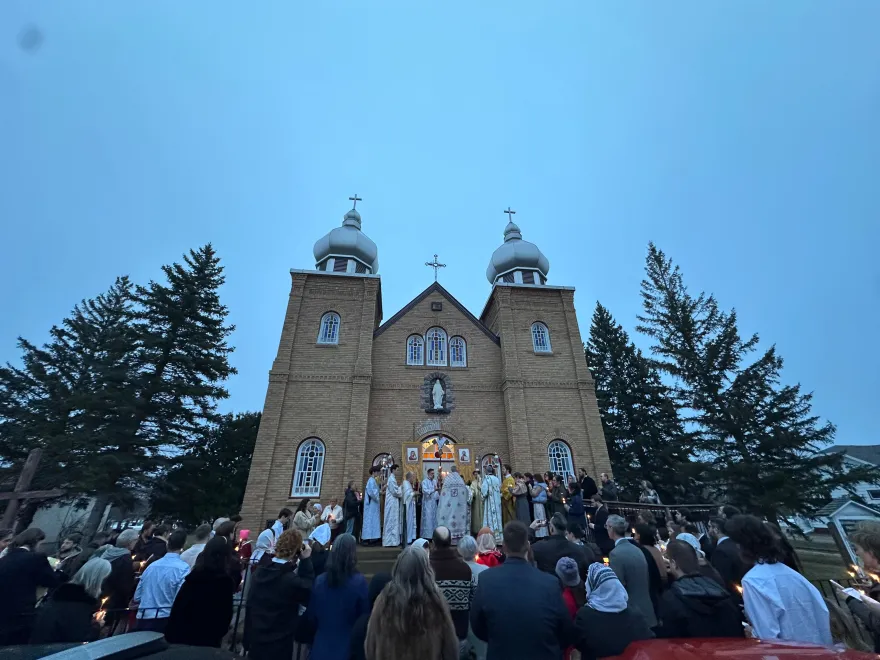
Unity and life -a “prairie Pascha” (reflection on the 50th anniversary of Holy Resurrection in Saskatoon, and the ordination of Fr. Johnathan Goosens, and Dn. Edwin Hay)

As many of you know, last weekend I was in Saskatoon at the parish of Holy Resurrection. The wonder is that what I witnessed and participated in, was that of the unity and life of our Church.

The very fact that we were celebrating the 50th anniversary of Holy Resurrection, a community that had very humble beginnings (not unlike many other communities in our Archdiocese, including our own), and that we were present to shout “Axios” (worthy) for the ordination of Dn. Johnathan Goosens to the priesthood, and our own (by extension) Subdeacon Edwin (Cam) Hay to the diaconate, was truly amazing enough. Yet, there was something even more amazing than this.

Surrounding our beloved Archbishop Irénée were 11 priests and 9 deacons, (from Manitoba to BC) and about a hundred faithful, all offering our thanksgiving to God for what He has done, and what He is doing. Truly this speaks volumes to the indwelling presence of the Holy Spirit in our Church, and the unity of our faith.

Fr. Matthew Francis (Holy Apostles Mission in Chilliwack BC) described the weekend as being something like a “prairie Pascha”! No words could be truer. Indeed at Pascha, there is an unparalleled sense of unity and even a kind of closeness that sees no one as being a stranger, having experienced and participated in the Lord’s joyful and radiant victory over sin and death. This brings to mind the verse from the Paschal canon which beautifully exemplifies this, “let us call brothers (and sisters) even those who hate us, and forgive all by the resurrection, and so let us cry, Christ is risen from the dead, trampling down death by death, and upon those in the tombs bestowing life.”

This victory lavished upon all humanity in the Lord’s saving Pascha, is an event that should permeate every moment of our lives (especially when we celebrate the divine liturgy, a “little Pascha”). For the Lord in His love and work for us, has brought into harmony the discordance of our broken and individual lives, and by effect brings us in harmony with our family, friends, strangers and even enemies. Although I did not know some of the clergy or faithful there: I was as close to them as if they were indeed my own brothers and sisters. Although I might had had disagreements with some of clergy and faithful: we were in perfect accord. Although I hadn’t seen some of the clergy and faithful in years: I was as close to them, as if they lived next door. Truly it was paschal in every way. 

Of course we all had to go our own way back to our own lives, homes and parishes. Yet beyond the celebration of an amazing and miraculous 50 years, and the ordination of a priest and deacon, what was experienced, was that which is at the heart of our life as Christians – the proclamation of Gospel and the Lord’s saving work for humanity, and our unity with and in the Lord and His faithful, being members of His Body, the Church – regardless of where we came from, what we do, or even if it wasn’t Pascha. 

May the Lord grant us the eyes of faith to see this Paschal unity and life in even the most isolated and lonely movements of our lives; regardless of where we are, or day or season it might be! And may the Lord grant many years to the clergy and faithful of Holy Resurrection in Saskatoon, and to the newly ordained priest Johnathan , and deacon Edwin, and their family’s!

Christ is Risen! Indeed He is Risen!

The Nativity of the Theotokos – The context of salvation.

This week  we celebrate the first feast of the Church year, the Nativity of the Theotokos. Although this  is not a scriptural feast (Like the Annunciation) it nonetheless has been woven into the spiritual and liturgical life of the Church for many centuries. Indeed this can be a challenge for many people trying to understand Orthodox Christianity as it gives the impression that we are adding stuff to the Gospel, or that  the scriptures are not enough. Yet if we scratch the surface of a feast like the Nativity of the Theotokos, we see that everything about Mary, is about her son Jesus, and the witness of the Lord’s saving love as revealed in holy scripture… or to quote Fr. Thomas Hopko ” The Gospel is not about Mary, but Mary is certainly about the Gospel!” 

In all those feasts that are dedicated to her, what is brought to our attention is the whole economy (working out) of salvation. Her being conceived by Joachim and Anna (which we are celebrating), her nativity, her entrance into the temple (Nov. 21st), her conception of our Lord God and Saviour Jesus Christ at the Annunciation of Gabriel (March 25th), and her Dormiton (Aug. 15th), speak with clarity about the love of God for His creation, and the length He goes to save us; “who, being in the form of God, did not consider it robbery to be equal with God, but made Himself of no reputation, taking the form of a bondservant, and coming in the likeness of men”(Phil. 2:6-7).   

The through line of all that is celebrated those feast days that focus on her, is the principle that the Lord’s saving work was never demonstrated  in a vacuum.

 It started with Israel’s covenant with the Lord, and the struggles to follow Him as witnessed by the holy men and women who clung to the Law, the Psalms, and the Prophets. This struggle continued with the righteous Joachim and Anna, who in faith conceived, and brought forth a child in their barren old age -Mary – who in the fullness of time brought forth her son and our saviour, Jesus Christ. Emanuel, God with us!  

In the same way that the Lord worked with humanity, and through history, He continues to work with us; here and now. What was accomplished by the Old Testament those many prophets, kings, men and women like Joachim and Anna, who although  “having obtained a good testimony through faith, did not receive the promise” God having provided something better for us,” (Heb. 11:39,40) is now accomplished by us through the grace of the Holy Spirit “poured into our hearts” (Rm. 5:5). For if the Lord  in His love for Humanity, did not act independently or arbitrarily in His saving work in those days of old, why would he do it now?  

This feast of the most holy Theotokos’ nativity is the perfection of a promise to redeem Israel and all humanity, manifested not in some awesome demonstration of divine power that would put most amazing CGI to shame, but in the most basic and natural way; through people willing to trust in the Lord, through a family. 

Although not a part of scripture, this feast of the Nativity of the Theotokos and ever virgin Mary, profoundly expresses the scriptural principle of the Lord’s saving love – “For God so loved the world that He gave His only begotten Son, that whoever believes in Him should not perish but have everlasting life. For God did not send His Son into the world to condemn the world, but that the world through Him might be saved”. (Jn. 3:16-17). By the prayers of the most holy Theotokos and ever virgin Mary, and like the saints who throughout all the ages have placed their trust in Him (those “who hear the word of God and Keep it” (Lk. 11:28)).

May we also strive to work with a God who comes to save us, by being with us, by working with us, and profoundly, by being like us in every way except sin.

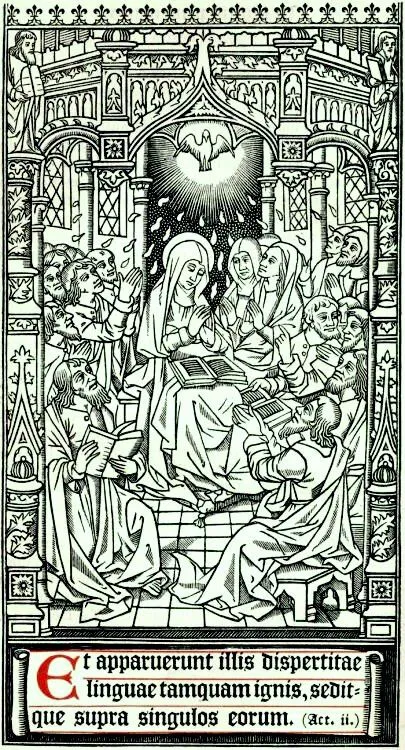
The longing to kneel – The Vespers of Pentecost (the kneeling prayers) 

A particular element of Pentecost is the serving of Vespers of Pentecost and Kneeling prayers immediately following the Divine Liturgy. Yet given our circumstances (being a Church that takes a bit of work to get to  for a majority of our members), serving the full Vespers is not a practical option- as such we simplify the service, sing a number of the Pentecost Vespers hymns and read the “Kneeling prayers“. These prayers mark the  beginning of  a new cycle in the Church and our pilgrimage through time and history in what is generally called“ordinary time.” As Fr. Alexander Schmemann beautifully notes in describing this movement  “

It is evening again, and the night approaches, during which temptations and failures await us, when, more than anything else, we need Divine help, that presence and power of the Holy Spirit, who has already revealed to us the joyful End, who now will help us in our effort towards fulfillment and salvation”.

This “need” for “Divine help…presence and power of the Holy Spirit” compels us to kneel in supplication, for  ourselves, all creation, and even those who have fallen asleep in death.

There are three beautiful prayers read, that plead for the Lord’s assistance in helping and teaching us to follow the true path in “the dark and difficult night of our earthly existence.” The last prayer being set apart for all those who have departed this life before us, recognising that it is by the Holy Spirit “the giver of Life” that we love and know love; something not even death can separate us from, either in this age, or in the age to come. 

Indeed there is a peculiar joy of being able to kneel in prayer again; in solidarity of those who in every generation humbled themselves by kneeling in prayer for us. for in this  “we are strengthened by the words of the Disciples, who revealed the glory of the Benefactor and God of all. Let us bend our knees and hearts with them. since we are strengthened by the Holy Spirit, bowing down in faith to worship the Savior of our souls!  (Tone 3 Aposticha – Vespers of Pentecost) 

How could this not be something we long for.

Pascha, Ascension and Pentecost – A “trinity of feasts”

We are in the twilight of this blessed season of light and life. Our joyful proclamation  “Christ is Risen!” ends as we celebrate the “leavetaking of Pascha”, and is replaced with both wonder, as we witness the Lord of Glory ascending into heaven to be seated at the right hand of the Father, and hope, as we are called to wait and “tarry…until you are endued with power from on high.” (Lk 24:39) on the blessed feast of Pentecost.

Indeed over the next 15 days or so we are called to reflect upon something of a “trinity of feasts” (Pascha, the Ascension, and Pentecost) – an unofficial yet apt description of the whole economy and working out of the Lord’s saving plan for us, revealed seamlessly in our services over the span of a few weeks.

We are called to joyfully reflect upon the eternal Pascha, of a God who liberates humanity from the ravages of death, by transforming death into life – by His death. We are called to reflect upon the Lord’s Ascension, with jubilation as our very human nature (flesh and blood) is reconciled and sat the right hand of the Father in the kingdom of heaven;  and we are called to radiantly reflect upon His promise for Pentecost, that He will not leave us orphans or as a flock without a shepherd, as we wait in anticipation for the outpouring of the Holy Spirit, the“Comforter”  (Jn. 14:16) who “will guide you into all truth” (Jn. 13:3).

Of course this kind of perspective is a bit of a paradox (like many things in our faith) challenging our understanding of a logical progression of time and events (how can the past, future and present be considered uniquely, yet conveying unity?) Yet in many ways this “trinity of feasts” bears resemblance to the paradox of the Holy Trinity itself; Father, Son, and Holy Spirit – One God (Homoousios ὁμοούσιος), in Three Persons (Hypóstasis ὑπόστασις). Unconfused distinction, in total unity, the source and substance of boundless love and communion.

Indeed, like the understanding of the Holy Trinity, our understanding of what this “trinity of feasts” reveals is the same – the witness of the Lord’s boundless love and communion for us, as experienced through faith. Faith in a God who has acted to save humanity eternally from sin and death. Faith in a God who ascends to “prepare a place” for us (John 14:2-3)  that we might truly become “communicants of life eternal”; and faith, in which we are constantly being transformed by the abiding presence of He “who is everywhere present and filling all things”. 

It is in this all that we are given an opportunity to understand simultaneously (in a manner), what the Lord has done for us (the past -His eternal Pascha shared with humanity in baptism), will do for us (the future – His eternal Ascension, and glorification of our humanity –Theosis), and is doing for us (the present – His eternal Pentecost, lived out in our Chrismation). Truly the witness of  His boundless love and communion.

It is truly a blessing that in these 15 days or so, we can be by faith be immersed in this “trinity of feasts” – Pascha, Ascension, and Pentecost  – the gift of divine love received; the promise of  divine love hoped for; and the participation of a divine love poured out on all flesh; “Now and ever and unto the ages of ages”. Amen! 

Pascha the context of any anniversary. (Always unique and familiar)

No anniversary that has love as its context ever seems the same; regardless if it is a birthday, wedding, birth, graduation or founding. Despite the celebration of a singular event over and over again, our remembrance of those blessed events, never seem to get old or tired – in fact they become all the more precious, profound, and engaging; feeling as new and unique as the day one got married, had a baby, celebrated a birthday, graduated, or founded a church or home – yet being familiar and intimate, as if we had always shared in this love with those around us.

In many respects our celebration of Holy Week and Pascha is no different than any anniversary – in so far as what is remembered and celebrated is both so new, singular and unique, while at the same time reassuringly familiar and personal; regardless if that past event happen years (or centuries) ago.

Of course this has much to do with the scriptural and liturgical witness of our faith. The word commonly translated as “remembrance”  is from the Greek  (ἀνάμνησις – anamnésis) which is used to describe the celebration of the Passover (Ex. 12:14) or the Mystical Supper (Lk. 22:19) conveys something greater than just a memory or recollection (Gk. μνήμη -mnémē). In this context anamnésis describes the participation – in the present – of a past event. Indeed our anamnésis or “remembrance” of the Lord’s passion, death and resurrection, is our participation in something new and unique, yet at very familiar and intimate – in a past event.

In this feast of feasts, we ultimately are participating in the  eternal and cosmic revelation of  God’s saving love. I think about this every year, as it feels like this is all new for me; filling me with awe, wonder, and fear. As I was reflecting on this, I realised that I feel this way (to one degree or another) anytime I celebrate my wedding anniversary, one of our children’s birthdays or those important events that have love as its context or foundation.

To be sure, these feelings of awe, wonder and fear, aren’t  because I don’t know how to serve throughout Holy Week and Pascha, or how to be a husband and raise a family, ect. (I do know what I am doing – well at least most of the time). Rather, I have come to see in this all, how cosmic and eternal, encompassing and transformative this love is – regardless of if it from my wife, children, friends, or from the Lord of Glory Himself. It is in this that I have come to understand that everything has been changed by the Lord’s passion, death and resurrection.

The Lord’s victory over sin and death, reveal the divine principle of love, and nothing less than it! He is the divine source of love in what He does for us, He bears witness to this love for us, and He goes so far as to offer Himself in His love for all humanity.  St. John the theologian perfectly qualifies this all  in proclaiming that this love of God “was made manifest among us, that God sent his only Son into the world, so that we might live through him.  In this is love, not that we loved God but that he loved us and sent his Son to be the expiation for our sins.” (1 Jn. 4:9-10)

Although Holy Week, and Pascha are profoundly unique (truly an understatement) having both an eternal and historic significance, they nonetheless reveal something reassuringly familiar and personal, that brings consolation and peace. Something that has being witnessed by generations of men and women over thousands of years – and by new generations for the first time this year (Glory to God!)

Indeed the Resurrection is more than a past event, we mystically participate in every spring, or on every Sunday (little Pascha’s), as it is a manifestation of a divine, eternal transformative and encompassing love; springing from the Cross and empty tomb of the Lord on the third day. It is our very immediate and present participation in His love, that is new, full of awe, wonder, and fear. No wonder I feel the way I do during Holy Week and Pascha, let alone when I celebrate an anniversary!

The effects of this participation in our “remembrance” of Holy Week and Pascha, are revealed throughout all time and creation, marking those moments of love as celebrated in any of our anniversaries, as being all the more singular and eternally unique, while at the same time being eternally familiar and personal; revealing God’s love for us, and our love as being all the more precious, profound, and engaging, without ever feeling tired or old. 

May we see in any anniversary founded on love, the same divine love that triumphed over the darkness of sin and death in the Lord’s Holy Pascha, as it is the same love that is the eternal foundation of our commutations in love, of those birthdays, weddings, births, or graduations we celebrate. As such may we proclaim in our hearts “Christ is Risen from the dead, trampling down death by death. And upon those in the tombs bestowing life!” as being that which has made everything new and unique, yet as familiar and intimate as if we had always shared in this love with those around us.

Christ is Risen! 

Sunday of Orthodoxy (Dn. John Schantz)

(This sermon was offered by Fr. Deacon John Schantz at the Sunday of Orthodoxy Vespers, served at St. Demetrios Greek Orthodox Church on Sunday March 9th 2025)

Fathers, brothers and sisters, Glory to Jesus Christ, Glory Forever!

This evening, we remember the conclusion of a battle which was waged in the church for over 100 years over icons. There is ancient testament to the presence of icons very early in the history of the church, but around the year 700, opposition started to mount to the use of icons in the church. Iconoclastic emperors arose who forbade the production and use of icons.

Our feast today commemorates the return of icons into the Great Church, in Constantinople in the year 843 – this time, iconoclasm came to end, at least in the church. Sadly, many icons were destroyed, and many people were persecuted, some even to death, for the making and using icons.

Since that time, the use of icons has been settled in the church. However, you may have noticed an increase of iconoclastic ideas from online characters who are again trotting out many of the same arguments which were brought against icon veneration in the past. Some decry the making of the icons, some the veneration of icons. None of the arguments are new and they have all been answered in the past by beloved saints such as John of Damascus and Theodore the Studite as well as the Fathers of the 7th Ecumenical Council.

One of the most dangerous ideas is that icons are quaint items that might have been useful as teaching tools in the past, but they are no longer needed because we have better ways of educating our flocks. Tied to this is the idea that they should not be venerated. This perspective misses that the icon is not simply a tool. The icon is a way that we show love, it is a way that we remain in communion with Christ and his saints.

A read through the John of Damascus’ defence of icons is recommended for anyone interested in the topic. But for the purpose of this talk, I wanted to point out that his writings are not simply a defense of icons, as a kind of appendix to the Christian faith. No, for John, the icon is not an optional extra; it is the proof of Christ’s saving work in humanity. And if we don’t have the icon, we don’t have the Gospel.

You see, Christianity has a problem. We speak of God as unknowable, inconceivable, indescribable, uncontainable. And if all these things are true, which they are, how do have a chance of “knowing” God in any meaningful way? The answer to this problem is the entire economy of salvation. Thankfully, as the Psalms attest, and as we sing in our services,“God is the Lord and has revealed Himself to us.”

John of Damascus asserts that the way God reveals Himself to us, is through imagery. We can’t see him or understand Him or define Him, but we can come to know something of God through imagery. In the language of John “Every image makes manifest and demonstrates something hidden…[images]…guide us to knowledge and make known what is hidden, for our profit and salvation.” 

He gives examples of different kinds of images, including the Trinity imaged in the sun, its light and its rays, the mother of God imaged in the burning bush and Aaron’s budding rod, and the serpent on a pole imaging Christ’s overcoming of the primordial serpent. He also talks about images which God commanded Moses to make in the tabernacle: the cherubim, the bronze pomegranates, the images on the veils. Indeed, even the Tabernacle itself was an image of the Cosmos.

But even more importantly are the images of humanity, and that of Christ Himself. Humanity is made in the image of God, as we learn in Genesis chapter 1. We know that image was marred in the fall. Marred but not lost. However, Christ (the Logos of God) is not, in the image of God, He is the image of God. In Christ, the problem of God’s unknowability, His inconceivability, indescribability, uncontainability, are all answered. The God who cannot be seen and who cannot properly be named in the Old Testament, takes on a body, name and a face. Thus we can see him, we can call His name, we can paint his image!

At first glance, this seem to be at odds with the commandments. The commandment not to make images was because God could not be imaged. But in Christ, He is revealed to us. (Whoever has seen me has seen the Father). All this leads John to say: 

I venerate the Creator… who came down to his creation without being lowered or weakened, that he might glorify my nature and bring about communion with the divine nature. I venerate together with the King and God…his body, not as a garment, nor as a fourth person (God forbid!), but as called to be and to have become unchangeably equal to God…For the nature of flesh did not become divinity, but as the Word became flesh immutably, remaining what it was, so also the flesh became the Word without losing what it was, being rather made equal to the Word hypostatically. Therefore I am emboldened to depict the invisible God, not as invisible, but as he became visible for our sake, by participation in flesh and blood.

John points out that he could have come as an angel, but he makes himself lower than the angels, and comes of the “seed of Abraham”. In so doing, He restores the marred image of God and raises our humanity to be in communion with the divine nature.

This is why, John points out, that we do not see images of humanity in the Old Testament, nor do we see Synagogues named after humans. Humanity was in a fallen state, prior to Christ, but in Christ, humanity has the chance to partake in the image of God. So the images are not simply images of people, but they also becomes images of God (yet another revelation of God) in some way. 

This is why we make images. The icon is not, nor has it ever been primarily about information. It is about communion. It is about entering into relationship with Christ and, by extension, with all of the saints. Of course, we should also remember that John distinguishes worship from veneration and points out numerous examples in the Old Testament of veneration being offered to someone other than God. Jacob blesses Pharaoh and falls down before his brother Esau, and Daniel falls down before the angel of God, as but a few examples. So, veneration is proper and it is not possible to distinguish worship from veneration simply by observation, he points out that the purpose behind the act is what differentiates them.

Do we worship the wood and paint? No! he points out that we burn the wood when it is worn out. Instead he says, “We therefore venerate the images not by offering veneration to matter, but through them to those who are depicted in them.” “For the honour offered to the image mounts up to the archetype.” as the divine Basil says.” 

So, we see that icons are not merely a quaint teaching tool. Icons are, in some way, the focal point of the Gospel itself. And this is what we celebrate today.

One word of caution should be offered here. It is easy to be triumphalist in that we have this beautiful theology of the icon, and this is something worth celebrating to be sure. However, we saw that the theology of the icon is firmly built on the foundation of humanity being in the image of God. In our triumphalism, it is important to remember that our veneration of the icon means nothing if we do not also venerate the human person who is in the image of God.

By this I do not mean to denigrate the icon, but I also want to remind us that we are in danger of denigrating the icon by our actions if we do not also venerate the image of God

In our family members
In our brothers and sisters in Christ
In the beggar we encounter on the streets
In our co-workers
In the person whose politics are opposed to our own

Simply put, the icon “doesn’t work” if we lose sight of the image of God in those around us.

By the prayers of the fathers of the Seventh Ecumenical Council, of St John of Damascus and St. Theodore the Studite and of all those who suffered for the making and veneration of icons, may we be able to see the image of God in all of the icons that He has provided for our benefit.