Sermon for the 3rd Wednesday of Great Lent (Genesis 7:6-9).

As we have moved through the readings of Great Lent, we started with the creation stories. We learned about the unique calling that we were given as human beings, who are the bridge between heaven and earth. However, almost immediately after this, we heard how humanity fell and hides from God, and is ultimately expelled from Eden.   Shortly after that we see Cain slaying his brother and moving to Nod. In the Septuagint, it reads that Nod is opposite Eden. This is not to mean, next door to Eden, but it is better thought of as opposed, or the opposite of Eden.

St Clement of Alexandria points out that Nod means “disturbance,” Eden, “the good life.” What can be a more pointed word-picture than opposite Eden? But here is where humanity finds itself. Opposite Eden in every way. We find ourselves in patterns of disturbance, if that isn’t an oxymoron. Everything in our lives is marked by disorder. And right on its heals comes death. 

Death, death and more death. We read about the death of Adams descendants in Genesis 5. The culmination of the story of each of his descendants is that they die. “And he died”, except for Enoch who, “walked with God”. 

And at the end of the story of Adam’s descendants who all die, we heard the story of a world that is truly opposite Eden. “Then the Lord God saw man’s wickedness, that it was great in the earth, and every intent of the thoughts within his heart was only evil continually (6:5).” Today’s reading is strangely a few short verses of a larger passage that was prescribed for yesterday’s reading. It sort of hyper-focuses on the entrance into the ark.

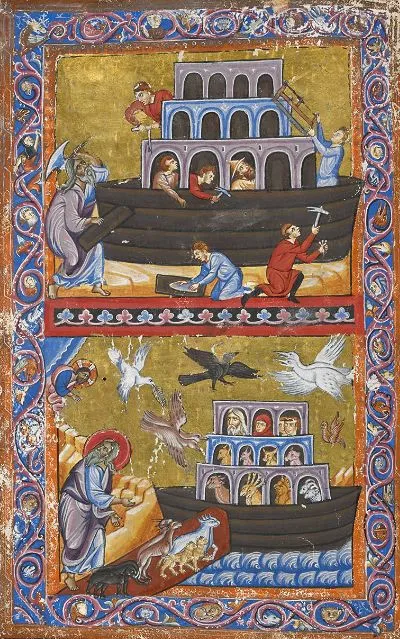
Noah was six hundred years old when the floodwaters were on the earth. So Noah, with his sons, his wife, and his sons’ wives, went into the ark because of the waters of the flood. Of clean animals, of animals that are unclean, of birds, and of everything that creeps on the earth, two by two they went into the ark to Noah, male and female, as God had commanded Noah. 

Noah and his family are entering the ark that will save them from the floodwaters that are about to come. This is a story that gets told and retold throughout the pages of Scripture in various forms. God will preserve a faithful remnant. What is remnant? For those who sew, or for a carpenter, the remnant is something left-over. It is a piece of cloth or a chunk of wood that is too small to be useful. You might just throw it in the garbage or into the fire because you have no use for it.

 Another example of this story is seen in today’s reading from Isaiah chapter 10. Isaiah is lamenting that Israel has become disobedient to God. They disregard the poor and the needy. They take advantage of the orphan and the widow and God is about to bring judgement on them by allowing them to be invaded by the Assyrians and carried off so that only a remnant will be left. Though their numbers were as the sands of the sea, a remnant was going to be left which was such a small number that even a child could count them. 

This story of the remnant that is protected by God, is told by St Paul in Romans, who identifies us as the remnant, grafted into Israel. The fathers also tell the same story. And it is the story told in the Apacolypse of John.

Indeed, this story (these stories) are about us when we are ruled by our passions. This is where we find ourselves, a remnant, opposite Eden. But God doesn’t throw the remnant into the fire. Instead, this remnant is the very thing He is going to build his project with or sew his garment with. God promises to nurture and protect his remnant, just as He did in the days of Noah.

So what does this mean for us? 

When we find ourselves, “by the waters of Babylon,” when we find ourselves “opposite Eden” what are we to do? Well, the answer is at the same time both simple and yet exceedingly hard. Because another aspect we see in the remnant in Scripture is that what is required of them is faithfulness to God. Noah was obedient to God in building an ark when no one had ever seen rain on the earth. The prophets likewise tell us that, “The remnant of Israel shall not do iniquity, nor speak lies; neither shall a deceitful tongue be found in their mouth (Zep 3:13).” And St John, in his Revelation tells us that the remnant are those who keep the commandments of God. 

Likewise, our participation as members of the remnant is to be faithful and obedient to the commands of the Christ. His first command is to repent. We are offered this season to repent; will we take up that offer? In Matthew 25 on the Sunday of Last Judgement we heard other commandments: feed the hungry, cloth the naked, give the food and water to those who hunger and thirst, visit those in sick or in prison. Will we follow these commands or will we be distracted, yet again, by our passions?

Through the prayers of his holy prophets and the evangelists who show us the way to live, may we learn obedience to the commandments of Christ. 

March 11th 2026

Dn. John Schantz

The Temptation of Christ, and our Lenten Discipline. (Esther G. Juce)

The Temptation of Christ According to Luke 4:1-13 and Its Application to Our Church’s Lenten Discipline

Luke 4:1-13, and its parallel in Matthew (Mt 4:1-13), used to scare me when I was a kid because they mentioned the devil.  Then, as I grew up, I learned that Christ has overcome the devil, and that there is no longer anything to fear.  So why are these potentially disturbing passages in the Bible in the first place?  The simple answer is that by showing us how Christ has conquered temptation, by His mercy and power, we can be able to do the same.

During Great Lent, the Church instructs us to increase our fasting, prayer, and almsgiving.   Luke 4:1-13 describes how Jesus uses these three graces to overcome temptation.  The setting of  this scripture is the desert, recalling the Israelites’ wandering in the wilderness for forty years during their journey to the Promised Land.  The Evangelist Luke tells us that for forty days Jesus also has been in the wilderness, and there is tempted by the devil.  Christ’s salvific responses to the devil’s three temptations not only fulfill scripture, but they also give us a guide for our own forty-day Lenten journey, and thus for our entire lives.  Let’s follow our Saviour’s way through the desert.

The devil uses many schemes to tempt Jesus.  Satan begins with pride:  “If you are the Son of God…”(Luke 4:3a, 9b) and “To you I will give all this authority and their glory…” (Luke 4:6a).  He continues with magic:  “…command this stone to become bread” (Luke 4:3b); and “…throw yourself down from here.” (Luke 4:9c).  Satan even quotes scripture in order to tempt our Lord:  In verses 9-11, Satan says, “For it is written, ‘He shall give His angels charge over you, to keep you,’ and ‘In their hands they shall bear you up, lest you dash your foot against a stone.'” (Luke 4:10-11 quoting Psalms 90 (91):11,12)  

Each temptation involves a different aspect of our fallen human existence and weakness. The first is about physical need, because Jesus is hungry after having had nothing to eat for forty days (Luke 4:2b).  The second temptation is about earthly power and glory (Luke 4:6).  And the third is about irresponsible and careless living (Luke 4:9-10).

Christ responds to these three temptations with scripture, all from the book of Deuteronomy.  These passages in Deuteronomy are set in the Israelites’ forty years of wandering in the desert.  The Hebrews did not fare well there; none of them made it to the Promised Land.  Thankfully, though, Jesus shows us the way:  His triumph over the temptations in the wilderness not only corrects the Israelites’ weakness, but also gives us a practical guide in how to follow Christ in overcoming our temptations on our journey with Him into the Promised Land.

The first temptation is that Jesus should turn a stone into bread.  He replies with Deuteronomy 8:3:  “Man does not live by bread alone…” (Luke 4:3-4)  Deuteronomy says that the Hebrews had been murmuring that they had no bread.  The passage then explains that the Lord was humbling the Israelites them in order to test them, to see what was in their hearts, and to see if they would follow His commandments.  God allowed them to hunger, and then fed them with manna from heaven (Deuteronomy 8:2-3.  See Exodus 16).  So the Lord fed them and took care of them:  He helped the Israelites to understand that they were, as we are, completely dependent upon God not only for food, but for all things.

The second temptation is that Jesus could have the power and glory over all of the kingdoms of the world in return for worshiping the devil.  Jesus replies with Deuteronomy 6:13:  “You shall worship the Lord your God, and Him only shall you serve.” (Luke 4:5-8)  Deuteronomy says that the Lord was reminding the Israelites that it was He, the Lord their God, who had brought them out of the house of bondage in Egypt. (Deuteronomy 6:10-12)  Because the Israelites accepted this deliverance, they were not to go after other gods, but to fear, worship, and serve the Lord their God only (Deuteronomy 6:13-19.  See Exodus 15:1-18).  So the Lord delivered them:  He reminded the Israelites of the love He has in His Covenant for His people, and therefore for us all.

The third temptation is that Jesus should throw himself off of the pinnacle of the temple to demonstrate that God would send His angels to save him.  Jesus replies with Deuteronomy 6:16:  “You shall not tempt the Lord your God.” (Luke 4:9-12).  This scripture in Deuteronomy alludes to the incident at Massah.  (Deuteronomy 6:16.  See Exodus 17:1-7)  Here the children of Israel had been complaining that they had no water to drink, putting the Lord to the test by saying, “Is the Lord among us or not?”  God answered by instructing Moses to strike with his rod the rock at Mount Horeb, and then water miraculously gushed out of the rock.  So the Lord responded to their testing (tempting) Him:  He put an end to their doubts and questions about Him by loving them and providing for them, as He does for us.

Yes, Christ’s responses to the devil’s temptations are based on scripture, but these responses also demonstrate the Lord’s love for us.  In every instance of the Hebrews’ grumbling, doubting, and unfaithfulness in the wilderness, God provided for them and offered them an everlasting Covenant.  In the same manner, the Lord responds to us in our time of need with His Love, extends his Covenant to us, and leads us to the Promised Land of His Kingdom.

Today, we, like Jesus, face these same temptations.  We are tested about our bodily needs, about the attraction of earthly power and  glory, and about living recklessly without care.  By allowing God to work in and with us, we have been given in His Church the tools to address these temptations.  During the Lenten season, we are instructed to fast from certain foods and activities in order to remember that we are dependent upon the Lord for all things.  We are instructed to increase our prayer in order to say “Yes” to the Lord our God and to His Covenant, and to therefore worship Him only.   We are instructed to increase our almsgiving in order to have more care for ourselves and for others.  By following our Church’s Tradition of fasting, praying, and almsgiving, both during Great Lent and extending to every day of our lives, we can work with our Lord to conquer the temptations that lie before us.

In conclusion, during our Lenten journey, let us follow the Lord Jesus, the Example of examples.  Let us follow Him into the wilderness in order to fight our temptations.  Let us increase our love of God and of our neighbours through more fasting, prayer, and almsgiving.  And let us accept and embrace the Lord, the One who has delivered us and who is bringing us into His Inheritance of the Promised Land.

Esther G. Juce