“Then their eyes were opened and they knew Him.” (a reflection on the Artos bread)

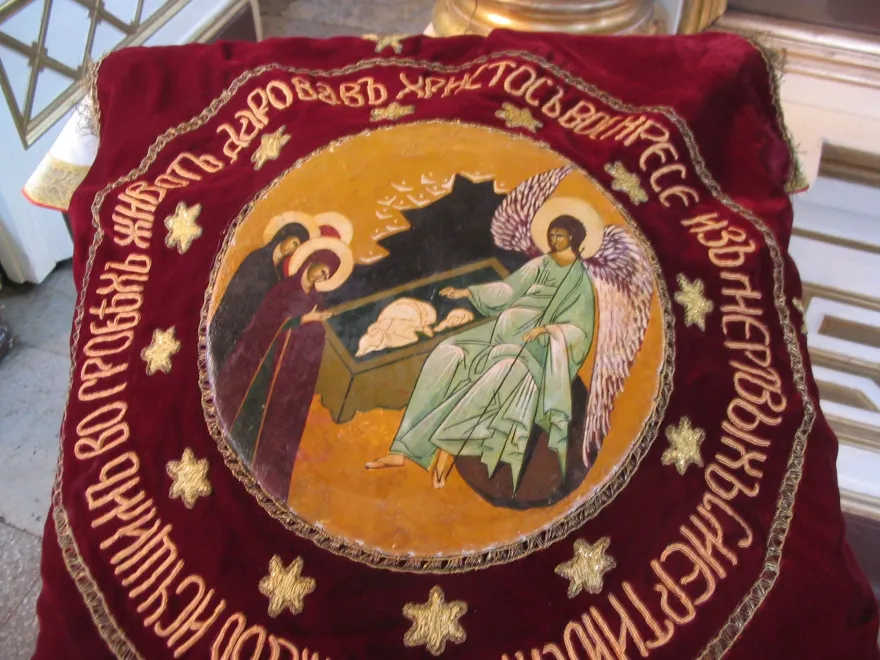
One of the elements that is part of our Paschal celebration, is the Artos, a large round loaf of bread, with an icon of the Resurrection, either stamped on it or placed beside it. The Artos is positioned on the Ambon in front of the Iconostas, for the Paschal vigil and liturgy and by tradition, remains there throughout the rest of the week (it moves in front of the open Royal Doors when services are not being conducted). Indeed there is something special about the Artos given its specific placement, and this is further emphasised by the specific prayers blessing this bread following the service. 

There are in fact two prayers. One prayer is said on the feast of Pascha, and the second on Bright Saturday (although it is generally deferred to Sunday). In the first prayer, a connection is made between the exodus of Israel and the Lord’s Resurrection. The commandment to slay a lamb for Israel’s exodus from Egypt – the Lord’s liberation of His people—prefigures the Lord’s sacrifice, “the Lamb of God” (Jn.1:29) who willingly was slain upon the Cross, taking away the sins of the world, and providing our release from the enemy’s eternal slavery and hell’s indissoluble bonds.  There is also a connection between the kissing and tasting of this bread, and our participation in this heavenly blessing, from He who is the “Fountain of blessings, and the Bestower of healings.” The second prayer expresses the foundational principles that Jesus Christ is not only the “Bread of eternal life” (Jn. 6:35), but also the source of superabundant mercy and nourishment. As He blessed those five loaves in the wilderness and fed the five thousand (Mt. 14:13-21), we pray that the Lord would bless this bread granting bodily and spiritual blessings and health to those who partake of it in faith. 

Given this, the question arises: What makes this bread any different from the Eucharist, let alone the blessed bread offered after a Litya/Artoklasia or memorial, or even the Antidoron (bread offered after the Liturgy)? Furthermore, what makes this bread so different that it is specifically prayed over on Pascha, and then offered to the faithful on the following Saturday or Sunday?

Well first off, this bread is not communion. In the Eucharist, the bread (and wine)  is offered, and is mystically changed (Gk. μεταβολή, Metabole ) to become the Body of Christ in the form of bread (St. Cyril of Jerusalem Catechetical Lecture 22.3); the Artos at Pascha is bread, that is blessed (Gk. Εὐλογημένος, Eulogemenos) to be just that, blessed bread. Secondly, what differentiates Artos from those other blessed breads is that they aren’t necessarily connected to any feast, or event, and can be offered throughout the year. Whereas Artos is prayed over, sprinkled/splashed with holy water, and offered on the feast of feasts – the day without end (thus the full week on the Ambon) – its very context is Pascha, and for good reason. 

In the same way that the disciples Luke and Cleopas  had thier eyes open when their companion  (the risen Lord – Lk. 24:30-31), blessed and broke bread;  we too, are compelled to open the eyes of our hearts, in the blessing and breaking of this Artos bread, and realize the reality of the Resurrection and the abiding presence of the risen Lord, who has journeyed with us, is journeying with us, and will journey with us through life.

Following the Liturgy the Artos will be cut up and distributed to the faithful. Various customs exist regarding the handling of the Artos. Some families cut it further into smaller pieces, let the particles dry, and keep them in their family Icon corner (or in the freezer). Just like our storage and use of the blessed water from Theophany, the Artos should be piously eaten when one is sick or unable to attend Church. Alternatively, there are some that eat the Artos immediately. 

Whatever the customs surrounding the Artos we might observe, we are compelled to reference its context –  the Resurrection. This was beautifully explained by an older friend of mine, who would say that any time she ate the Artos, she would say a prayer of thanksgiving, cross herself, consume the tiny bit of dried bread, and then sing “Christ is Risen,” regardless of the time of year. 

Pascha the context of any anniversary. (Always unique and familiar)

No anniversary that has love as its context ever seems the same; regardless if it is a birthday, wedding, birth, graduation or founding. Despite the celebration of a singular event over and over again, our remembrance of those blessed events, never seem to get old or tired – in fact they become all the more precious, profound, and engaging; feeling as new and unique as the day one got married, had a baby, celebrated a birthday, graduated, or founded a church or home – yet being familiar and intimate, as if we had always shared in this love with those around us.

In many respects our celebration of Holy Week and Pascha is no different than any anniversary – in so far as what is remembered and celebrated is both so new, singular and unique, while at the same time reassuringly familiar and personal; regardless if that past event happen years (or centuries) ago.

Of course this has much to do with the scriptural and liturgical witness of our faith. The word commonly translated as “remembrance”  is from the Greek  (ἀνάμνησις – anamnésis) which is used to describe the celebration of the Passover (Ex. 12:14) or the Mystical Supper (Lk. 22:19) conveys something greater than just a memory or recollection (Gk. μνήμη -mnémē). In this context anamnésis describes the participation – in the present – of a past event. Indeed our anamnésis or “remembrance” of the Lord’s passion, death and resurrection, is our participation in something new and unique, yet at very familiar and intimate – in a past event.

In this feast of feasts, we ultimately are participating in the  eternal and cosmic revelation of  God’s saving love. I think about this every year, as it feels like this is all new for me; filling me with awe, wonder, and fear. As I was reflecting on this, I realised that I feel this way (to one degree or another) anytime I celebrate my wedding anniversary, one of our children’s birthdays or those important events that have love as its context or foundation.

To be sure, these feelings of awe, wonder and fear, aren’t  because I don’t know how to serve throughout Holy Week and Pascha, or how to be a husband and raise a family, ect. (I do know what I am doing – well at least most of the time). Rather, I have come to see in this all, how cosmic and eternal, encompassing and transformative this love is – regardless of if it from my wife, children, friends, or from the Lord of Glory Himself. It is in this that I have come to understand that everything has been changed by the Lord’s passion, death and resurrection.

The Lord’s victory over sin and death, reveal the divine principle of love, and nothing less than it! He is the divine source of love in what He does for us, He bears witness to this love for us, and He goes so far as to offer Himself in His love for all humanity.  St. John the theologian perfectly qualifies this all  in proclaiming that this love of God “was made manifest among us, that God sent his only Son into the world, so that we might live through him.  In this is love, not that we loved God but that he loved us and sent his Son to be the expiation for our sins.” (1 Jn. 4:9-10)

Although Holy Week, and Pascha are profoundly unique (truly an understatement) having both an eternal and historic significance, they nonetheless reveal something reassuringly familiar and personal, that brings consolation and peace. Something that has being witnessed by generations of men and women over thousands of years – and by new generations for the first time this year (Glory to God!)

Indeed the Resurrection is more than a past event, we mystically participate in every spring, or on every Sunday (little Pascha’s), as it is a manifestation of a divine, eternal transformative and encompassing love; springing from the Cross and empty tomb of the Lord on the third day. It is our very immediate and present participation in His love, that is new, full of awe, wonder, and fear. No wonder I feel the way I do during Holy Week and Pascha, let alone when I celebrate an anniversary!

The effects of this participation in our “remembrance” of Holy Week and Pascha, are revealed throughout all time and creation, marking those moments of love as celebrated in any of our anniversaries, as being all the more singular and eternally unique, while at the same time being eternally familiar and personal; revealing God’s love for us, and our love as being all the more precious, profound, and engaging, without ever feeling tired or old. 

May we see in any anniversary founded on love, the same divine love that triumphed over the darkness of sin and death in the Lord’s Holy Pascha, as it is the same love that is the eternal foundation of our commutations in love, of those birthdays, weddings, births, or graduations we celebrate. As such may we proclaim in our hearts “Christ is Risen from the dead, trampling down death by death. And upon those in the tombs bestowing life!” as being that which has made everything new and unique, yet as familiar and intimate as if we had always shared in this love with those around us.

Christ is Risen! 

Archpastoral Message of His Beatitude Metropolitan Tikhon Pascha 2024

resurrection

To the Clergy, Monastics, and Faithful of the Orthodox Church in America, 

My Beloved Children in the Lord,

CHRIST IS RISEN! INDEED HE IS RISEN!

Now all is filled with light: heaven and earth and the lower regions. Let all creation celebrate the rising of Christ: in him we are established. (St. John of Damascus, Paschal Canon, Ode Three)

Today we greet the most radiant feast of feasts, the king and lord of days, the Pascha of Christ our true God. Standing in the light of the Resurrection, we glimpse the true and unfading joy of the life to come.

To be sure, even on this chosen and holy day of light-bearing festival, my own heart remains heavy as I look out upon the world and behold wars and terrorism, unjust imprisonment and persecution, civil strife and political divisions. Indeed, “the dark places of the earth are full of the habitations of iniquity” (Ps. 73:20). The world and its troubles present a threefold temptation to Christians who behold this multitude of “dark places”: we are tempted to despair; we are tempted to indifference; and we are tempted to conform and subordinate our holy Orthodox Christian faith to some worldly political program or ideology.

However, with his Pascha, Christ offers us a different response: a hope beyond this world, yet already present in this world. As we sing in the Paschal Canon of St. John of Damascus, everything is filled with the light of the Resurrection, even the lower regions. Life has burst forth from the grave; a light has shone in darkness (Jn. 1:5).

We dwell in a world of real trouble, real sorrow, real pain. The Lord came down into this world and became a man of sorrows, acquainted with grief, and he felt pain in his heart—on the night in which he was given up, his soul was “exceedingly sorrowful, even unto death”—and pain in his flesh (Is. 53:3; Mt. 26:38). But out of pain, the Lord has brought forth healing; out of sorrow, he has wrought an incorruptible source of joy. He died, but now he lives forever, and he offers us the same hope: eternal life.

And the eternal life that he offers is not just an extension of life in this world, with its ups and downs, sorrows and joys, sins and foibles and accidents. Rather he offers us abundant life, true life, by restoring our communion with God, who is the Source of life.

This true and incorruptible life, a life of constant trust and love and joy, is not only available in the world to come. Whenever we believe in Christ and his Resurrection and accept the joy of his Pascha, we are already, through faith and hope, getting a foretaste of that life—a life without fear of suffering or death, that sees sorrow as a source of joy, since even in sorrow, Christ, the Man of Sorrows, is there, ready to draw near to us in a union of love.

It is because of this that the holy Psalmist could write: “If I go up into heaven, thou art there; if I go down into hell, thou art present. If I take up my wings at dawn and dwell in the uttermost parts of the sea, even there shall thy hand guide me, and thy right hand shall hold me” (Ps. 138:8–10). 

Wherever we are, whatever troubles we experience in our lives, whatever troubles we behold in this world, Christ is there with us, suffering with us in our suffering and offering us the hope of the unfailing happiness of his Pascha, inviting us to be in the world and not of the world, storing up all our hope and all the treasure of our hearts with him, in the kingdom that has no end, where neither moth nor rust can destroy and where no thief can break in and steal (Mt. 6:20).

May he who rose from the dead on the third day, kindling the light of hope for all the world, always shine upon our hearts with Paschal light, filling us with a joy-making desire for the good things to come and changing all our troubles and cares into opportunities to hope and trust.

To him, the Risen Lord, be all glory and adoration, together with his Father and his All-holy Spirit, now and ever and unto ages of ages!

Yours in the Risen Christ,

+ TIKHON
Archbishop of Washington
Metropolitan of All America and Canada