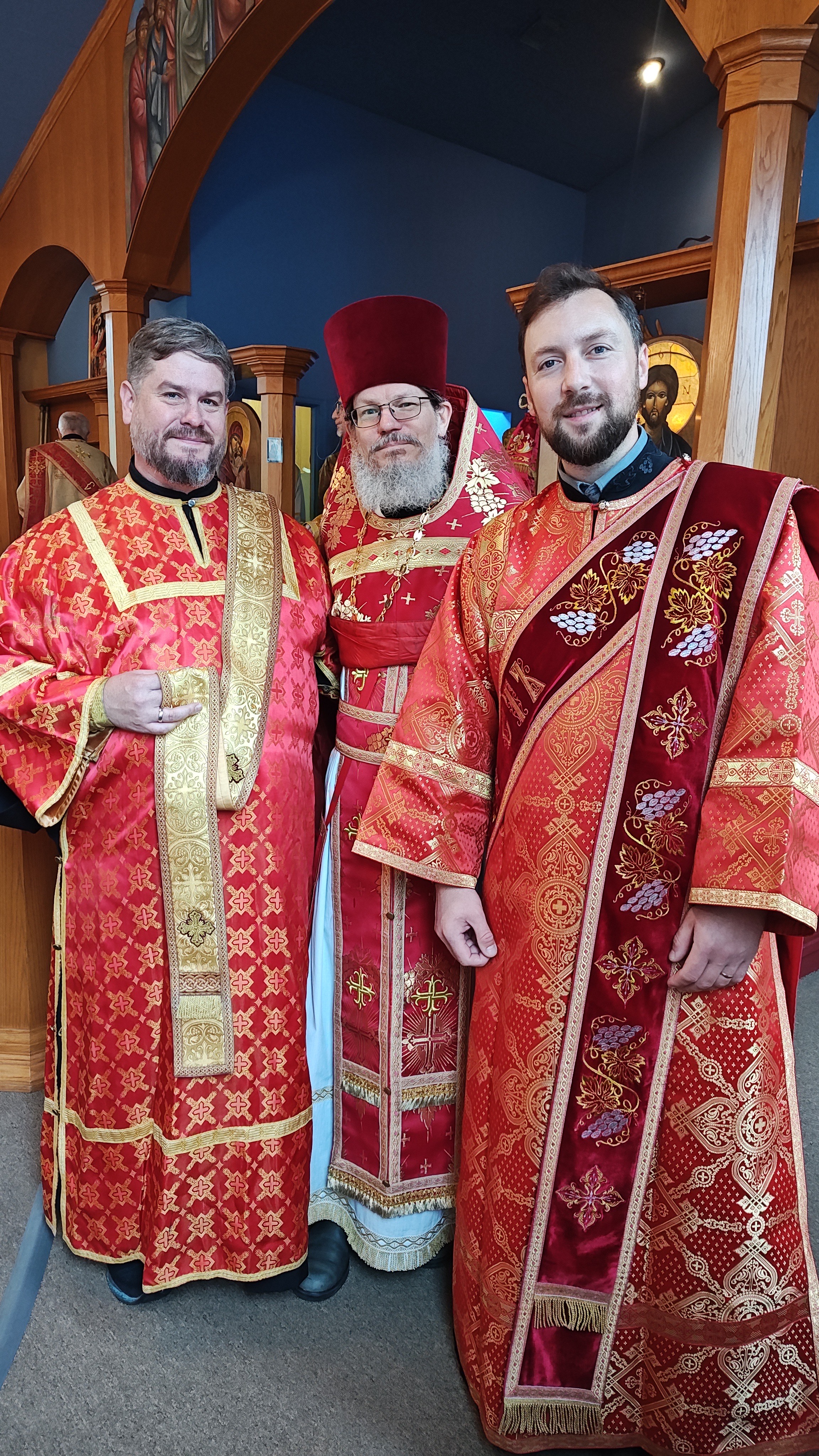
As many of you know, last weekend I was in Saskatoon at the parish of Holy Resurrection. The wonder is that what I witnessed and participated in, was that of the unity and life of our Church.
The very fact that we were celebrating the 50th anniversary of Holy Resurrection, a community that had very humble beginnings (not unlike many other communities in our Archdiocese, including our own), and that we were present to shout “Axios” (worthy) for the ordination of Dn. Johnathan Goosens to the priesthood, and our own (by extension) Subdeacon Edwin (Cam) Hay to the diaconate, was truly amazing enough. Yet, there was something even more amazing than this.
Surrounding our beloved Archbishop Irénée were 11 priests and 9 deacons, (from Manitoba to BC) and about a hundred faithful, all offering our thanksgiving to God for what He has done, and what He is doing. Truly this speaks volumes to the indwelling presence of the Holy Spirit in our Church, and the unity of our faith.
Fr. Matthew Francis (Holy Apostles Mission in Chilliwack BC) described the weekend as being something like a “prairie Pascha”! No words could be truer. Indeed at Pascha, there is an unparalleled sense of unity and even a kind of closeness that sees no one as being a stranger, having experienced and participated in the Lord’s joyful and radiant victory over sin and death. This brings to mind the verse from the Paschal canon which beautifully exemplifies this, “let us call brothers (and sisters) even those who hate us, and forgive all by the resurrection, and so let us cry, Christ is risen from the dead, trampling down death by death, and upon those in the tombs bestowing life.”
This victory lavished upon all humanity in the Lord’s saving Pascha, is an event that should permeate every moment of our lives (especially when we celebrate the divine liturgy, a “little Pascha”). For the Lord in His love and work for us, has brought into harmony the discordance of our broken and individual lives, and by effect brings us in harmony with our family, friends, strangers and even enemies. Although I did not know some of the clergy or faithful there: I was as close to them as if they were indeed my own brothers and sisters. Although I might had had disagreements with some of clergy and faithful: we were in perfect accord. Although I hadn’t seen some of the clergy and faithful in years: I was as close to them, as if they lived next door. Truly it was paschal in every way.
Of course we all had to go our own way back to our own lives, homes and parishes. Yet beyond the celebration of an amazing and miraculous 50 years, and the ordination of a priest and deacon, what was experienced, was that which is at the heart of our life as Christians – the proclamation of Gospel and the Lord’s saving work for humanity, and our unity with and in the Lord and His faithful, being members of His Body, the Church – regardless of where we came from, what we do, or even if it wasn’t Pascha.
May the Lord grant us the eyes of faith to see this Paschal unity and life in even the most isolated and lonely movements of our lives; regardless of where we are, or day or season it might be! And may the Lord grant many years to the clergy and faithful of Holy Resurrection in Saskatoon, and to the newly ordained priest Johnathan , and deacon Edwin, and their family’s!
The last few days have been full of introspection for me, with the falling asleep in the Lord of Fr. Anthony (Spencer) Estabrooks; and as I have been sifting through my time and interactions with him (which was admittedly limited and sporadic), I have come to realise just how much of a positive example of the priesthood he has been for me. If I am being honest, the youthful enthusiasm that enlivened my priesthood, was always an easy target for hubris and conceit. This stood in stark contrast with the quiet and reflective presence that Fr. Anthony provided. Regrettably this contrast skewed my understanding of this vocation (beyond its fundamental sacramental characteristics). Ironically, my understanding of priesthood’s validation was more formed by what “I” was doing, or what “I “thought a priest should do.
This understanding of what I thought validated the priesthood was tempered by those elements that Fr. Anthony demonstrated. What I came to realise was that the fundamental context or validation of the priesthood, was that of faithfulness as demonstrated in being a servant; for the Lord came “to serve, and not be served and give His life as a ransom for many” (Mt 20:28). Simply put, the Priesthood is Christ’s; the sacrifice and salvific work, is Christ’s – in which He had shared with Fr. Anthony (and all those called to the priesthood like myself).
This of course didn’t happen the moment he was ordained. In fact, for many years, Fr. Anthony (or Spencer as he was known then) was engaged as a layman, in the promotion and proclamation of Orthodox Christianity in English. This is something to consider, because by God’s grace, many of us take for granted nowadays; yet only a few decades ago, this was something of an oddity and even a betrayal. Even before his ordination, every moment presented the opportunity for him to bear witness to what the Lord was doing, and every person he met presented him the opportunity to invite them to participate with Lord in this work, regardless of whether he was Spencer, or Father Anthony.
Working closely with the Protoprysber Miron Kylsh, the Archpriest Anatoliy Melnyk, and our own Fr. Bob Kenaugh, he sought to offer our faith in a way that everyone could either encounter the Lord’s saving love, and or, deepen their relationship with Him. This all came together with the founding of the Saint Arseny’s Institute (SAI) in 2002, which provided an alternative option for theological education in Canada. This is something in itself, yet his work was certainly not limited to that – I would go so far as to say that it far exceeded this.
Although Fr. Anthony never intended to become a priest, (in fact he once told me at an Archdiocesan council meeting in 2006 that this was furthest from his desire – as he thought his talents were better served as a layman). Nonetheless, he was ordained to the Diaconate (at St. Nicholas) and then Priesthood in 2010, with the responsibility for serving the Life Giving Springs Mission in Winnipeg. His priesthood in many ways reconciled his many years of work, with the sacramental life of the Church – manifesting the Lord’s mystical presence and blessings as the context and application for his teachings and work.
What I have now come to see as being amazing (even profound), is that on the surface, his witness was subtle and unnoticeable – indeed one could say that it was unquantifiable. Yet the same way that love, as an expression of selflessness and sacrifice can seem quiet, subtle and hard to quantify – it is nonetheless verifiable. In like manner, Fr. Anthony’s humble love of God and neighbour alike, might not have been quantifiable, but was certainly verifiable in his life and especially his priesthood, as many people can attest – including me.
Although he never had proper liturgical training and his service was very limited – he nonetheless served, in his love for God and neighbour alike. Although he never really had administrative and dynamic skills or time to expand his community – he nonetheless was a father in every respect, in his love of God and neighbour alike. Although he never had the structure or forum to expound about his teaching and writings- he nonetheless inspired those around him, in his love of God and neighbour alike.
Although Fr. Anthony never manifested those elements or qualities that I initially considered as being maybe the only quantifiably important elements of the priesthood (proper liturgics, expansion of mission, and exposition of work, etc) I came to realise in time, that what he offered was the very foundation of all those elements, and even more! Nothing less than faithfulness to the Lord as offered in humility and thanksgiving, was more important to Fr. Anthony, regardless of whether he was in front of the Altar, or at home with his wife Matushka Irene, children and grandchildren. Like Mary (the sister of Lazarus) Fr. Anthony saw the exceeding value of sitting at the feet of the Lord, and hearing His words, rather than fussing around and being “distracted with much serving” like Martha (Lk. 10: 38-42). In many respects, this aspect of his ministry is somewhat reflective of the kind of work a good farmer employs
As most farmers might know, the hardest part of growing anything is not necessarily the toiling of the soil, or planting of the seeds, or even the harvesting of the fruits. Those things indeed take a lot of work to do; yet it is being patient and faithful that maybe the most difficult challenge to navigate. A farmer can hope that it will rain (and not rain too much), care for the young sprouts, and have faith that there will be a bountiful harvest; but beyond this, nothing really can make a crop grow faster, no matter how much fussing around and being “distracted with much serving” happens. This is something that Fr. Anthony understood as a principle in which he applied to his priesthood.
For as the Lord says. “The kingdom of God is as if a man should scatter seed on the ground, and should sleep by night and rise by day, and the seed should sprout and grow, he himself does not know how. For the earth yields crops by itself: first the blade, then the head, after that the full grain in the head. But when the grain ripens, immediately he puts in the sickle, because the harvest has come.” (Mk. 26:4-9). This was Father Anthony’s witness, as being entrusted to care for the Lord’s Vineyard- The Church.
We now find ourselves at a place where our churches are full and growing, indeed “the harvest has come” – wrought not by our own work, but by the grace of God. What I have been called to do, is like Fr. Anthony be faithful and patient with all that the Lord is doing. – for this harvest is of the Kingdom of heaven – and not of me or any other priest.
Yet often I wanted to see and have the fruits of my work as if the Lord wanted “results”. So often I have wanted to validate my priesthood by rushing or managing things beyond my control, because things had to be done – Alas, I have more often than not ended up being more frustrated than anything else. Yet the example of faithfulness, patience, and humility offered by Fr. Anthony was a witness to me what can happen when what is offered is of Christ, rather than just for Christ.
Indeed Fr. Anthony has compelled me to attend to the “one thing that is needful” in my life as a priest and Christian. For this I offer my profound thanksgiving to God for such a servant and priest, for he had“chosen that good part, which will not be taken away from him”.
May his memory be eternal!
Fathers Micheal Ungrin, Anthony Estabrooks, Nikolaos Tambakis, Evan Maximiuk, and myself in 2022.
This past week the Archpriest Nicholas Boldireff fell asleep in the Lord after a lengthy illness. Fr. Nicholas was the longtime pastor of Christ the Saviour Orthodox Church in Toronto and Holy Virgin Mary Russian Orthodox Cathedral in Los Angeles (CA); and although I never really knew Fr. Nicholas personally well, (even though I had served with him as a young server, and deacon) there is Nonetheless there is something very personal that I share with him.
There is an informal tradition in the Orthodox Church that when a priest is ordained, the pectoral cross given to him, is one that has been handed down to him from another priest (sometimes this isn’t practical so a new cross is given). This was the case for me at my ordination a decade ago. The cross that Vladika Irénée put around my neck (and also my brother’s neck at his ordination) was my father’s cross, that was passed to him by the newly departed Fr. Nicholas; that was passed to Fr. Nicholas by his father (Archpriest Oleg +1997), that was passed to Fr. Oleg at his ordination (and so on). There is something quite beautiful that this same cross (a simple pewter three bar cross) has been worn by more than a few priests for over a hundred years; yet it is more than just an heirloom passed from priest to priest. It is also a witness Apostolic tradition (the word trandition literally means passing on) and the unity of those called to “be an example to the believers in word, in conduct, in love, in spirit, in faith, in purity” (1 Tim. 4:12) in service to the Body of Christ as priests (in fact in the slavic tradition this scripture is written on the back of some pectoral crosses).
It is a kind of inheritance that I consider every time I put on this particular cross (which came back to me when my brother received my father’s gold cross), as it speaks to something greater than just being a special heirloom. It is a witness of the responsibility that is given to priests at their ordination (in general), and my father, Fr. Nicholas and his father (in specific); and their voluntary struggles as His servants which manifested that the Lord’s “strength is made perfect in weakness” and “that the power of Christ” not only rested upon them, but was also displayed (around their necks) for the world around them. (2 Cor. 12:9). Indeed this inheritance conveys something more than just an spiritual significance, but rather something that is very tangible and real; and thus profoundly personal – As real as the simple worn out and crudely mended cross that I wear on special occasions; and as real as that same cross which was Fr. Nicholas’ (and my father’s and his father’s etc.) personal and spiritual inheritance when he (and they) were called to serve the Lord as His priest.
Ultimately this particular cross (and all crosses whether they were passed down or were brand new) express that the“message of the cross is foolishness to those who are perishing, but to us who are being saved it is the power of God.” (1 Cor. 1:18). This is a constant source of inspiration for me, as it was for Fr. Nicholas and those who preceded him. Although I might not have known Fr. Nicholas as much as I would have wanted to; the love of God who by The Cross drew all peoples to Himself (Jn. 12:32), has also drawn me to know him through his priesthood, in ways more personal than words can convey.
Truly may his memory be eternal, and the Lord grant him the Kingdom of Heaven. Christ is Risen! Indeed He is Risen! Христос воскресе! Воистину воскресе!