Unity and life -a “prairie Pascha” (reflection on the 50th anniversary of Holy Resurrection in Saskatoon, and the ordination of Fr. Johnathan Goosens, and Dn. Edwin Hay)

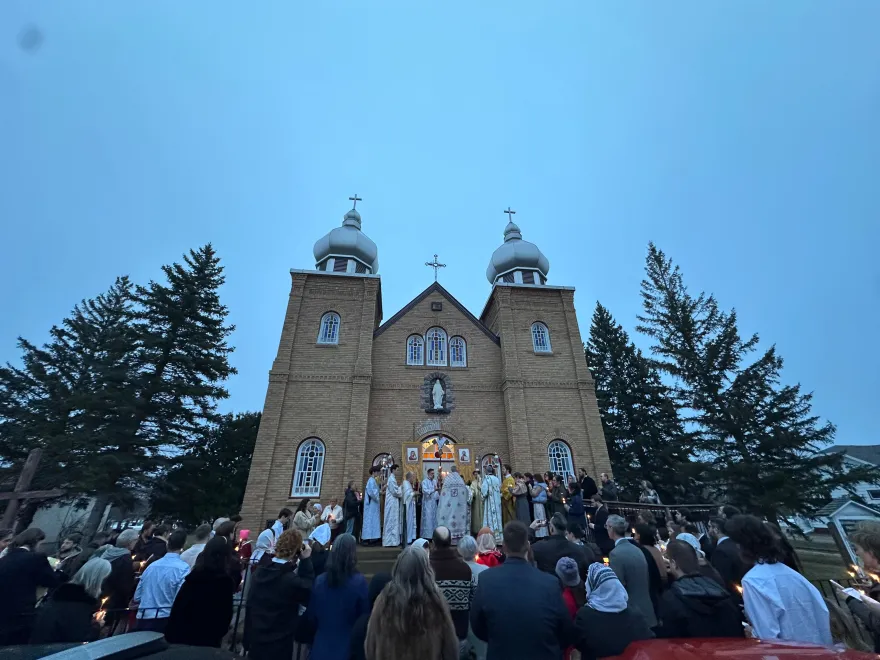
As many of you know, last weekend I was in Saskatoon at the parish of Holy Resurrection. The wonder is that what I witnessed and participated in, was that of the unity and life of our Church.

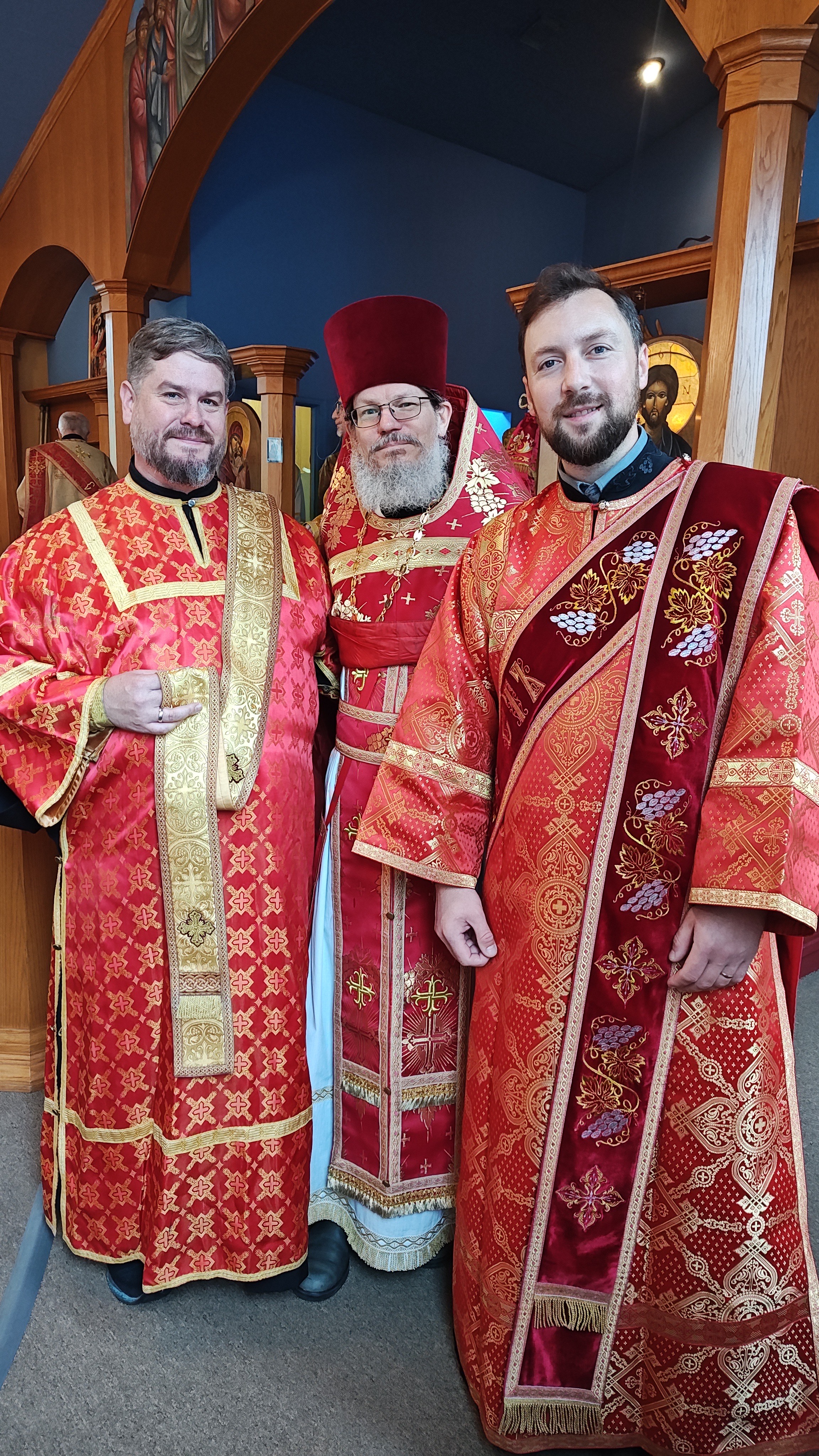
The very fact that we were celebrating the 50th anniversary of Holy Resurrection, a community that had very humble beginnings (not unlike many other communities in our Archdiocese, including our own), and that we were present to shout “Axios” (worthy) for the ordination of Dn. Johnathan Goosens to the priesthood, and our own (by extension) Subdeacon Edwin (Cam) Hay to the diaconate, was truly amazing enough. Yet, there was something even more amazing than this.

Surrounding our beloved Archbishop Irénée were 11 priests and 9 deacons, (from Manitoba to BC) and about a hundred faithful, all offering our thanksgiving to God for what He has done, and what He is doing. Truly this speaks volumes to the indwelling presence of the Holy Spirit in our Church, and the unity of our faith.

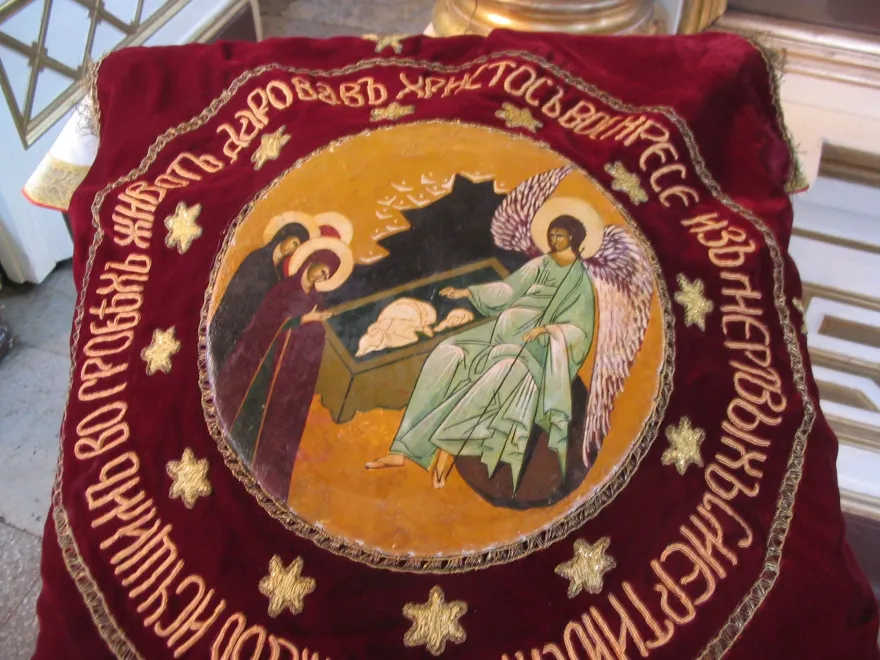
Fr. Matthew Francis (Holy Apostles Mission in Chilliwack BC) described the weekend as being something like a “prairie Pascha”! No words could be truer. Indeed at Pascha, there is an unparalleled sense of unity and even a kind of closeness that sees no one as being a stranger, having experienced and participated in the Lord’s joyful and radiant victory over sin and death. This brings to mind the verse from the Paschal canon which beautifully exemplifies this, “let us call brothers (and sisters) even those who hate us, and forgive all by the resurrection, and so let us cry, Christ is risen from the dead, trampling down death by death, and upon those in the tombs bestowing life.”

This victory lavished upon all humanity in the Lord’s saving Pascha, is an event that should permeate every moment of our lives (especially when we celebrate the divine liturgy, a “little Pascha”). For the Lord in His love and work for us, has brought into harmony the discordance of our broken and individual lives, and by effect brings us in harmony with our family, friends, strangers and even enemies. Although I did not know some of the clergy or faithful there: I was as close to them as if they were indeed my own brothers and sisters. Although I might had had disagreements with some of clergy and faithful: we were in perfect accord. Although I hadn’t seen some of the clergy and faithful in years: I was as close to them, as if they lived next door. Truly it was paschal in every way. 

Of course we all had to go our own way back to our own lives, homes and parishes. Yet beyond the celebration of an amazing and miraculous 50 years, and the ordination of a priest and deacon, what was experienced, was that which is at the heart of our life as Christians – the proclamation of Gospel and the Lord’s saving work for humanity, and our unity with and in the Lord and His faithful, being members of His Body, the Church – regardless of where we came from, what we do, or even if it wasn’t Pascha. 

May the Lord grant us the eyes of faith to see this Paschal unity and life in even the most isolated and lonely movements of our lives; regardless of where we are, or day or season it might be! And may the Lord grant many years to the clergy and faithful of Holy Resurrection in Saskatoon, and to the newly ordained priest Johnathan , and deacon Edwin, and their family’s!

Christ is Risen! Indeed He is Risen!

Pascha, Ascension and Pentecost – A “trinity of feasts”

We are in the twilight of this blessed season of light and life. Our joyful proclamation  “Christ is Risen!” ends as we celebrate the “leavetaking of Pascha”, and is replaced with both wonder, as we witness the Lord of Glory ascending into heaven to be seated at the right hand of the Father, and hope, as we are called to wait and “tarry…until you are endued with power from on high.” (Lk 24:39) on the blessed feast of Pentecost.

Indeed over the next 15 days or so we are called to reflect upon something of a “trinity of feasts” (Pascha, the Ascension, and Pentecost) – an unofficial yet apt description of the whole economy and working out of the Lord’s saving plan for us, revealed seamlessly in our services over the span of a few weeks.

We are called to joyfully reflect upon the eternal Pascha, of a God who liberates humanity from the ravages of death, by transforming death into life – by His death. We are called to reflect upon the Lord’s Ascension, with jubilation as our very human nature (flesh and blood) is reconciled and sat the right hand of the Father in the kingdom of heaven;  and we are called to radiantly reflect upon His promise for Pentecost, that He will not leave us orphans or as a flock without a shepherd, as we wait in anticipation for the outpouring of the Holy Spirit, the“Comforter”  (Jn. 14:16) who “will guide you into all truth” (Jn. 13:3).

Of course this kind of perspective is a bit of a paradox (like many things in our faith) challenging our understanding of a logical progression of time and events (how can the past, future and present be considered uniquely, yet conveying unity?) Yet in many ways this “trinity of feasts” bears resemblance to the paradox of the Holy Trinity itself; Father, Son, and Holy Spirit – One God (Homoousios ὁμοούσιος), in Three Persons (Hypóstasis ὑπόστασις). Unconfused distinction, in total unity, the source and substance of boundless love and communion.

Indeed, like the understanding of the Holy Trinity, our understanding of what this “trinity of feasts” reveals is the same – the witness of the Lord’s boundless love and communion for us, as experienced through faith. Faith in a God who has acted to save humanity eternally from sin and death. Faith in a God who ascends to “prepare a place” for us (John 14:2-3)  that we might truly become “communicants of life eternal”; and faith, in which we are constantly being transformed by the abiding presence of He “who is everywhere present and filling all things”. 

It is in this all that we are given an opportunity to understand simultaneously (in a manner), what the Lord has done for us (the past -His eternal Pascha shared with humanity in baptism), will do for us (the future – His eternal Ascension, and glorification of our humanity –Theosis), and is doing for us (the present – His eternal Pentecost, lived out in our Chrismation). Truly the witness of  His boundless love and communion.

It is truly a blessing that in these 15 days or so, we can be by faith be immersed in this “trinity of feasts” – Pascha, Ascension, and Pentecost  – the gift of divine love received; the promise of  divine love hoped for; and the participation of a divine love poured out on all flesh; “Now and ever and unto the ages of ages”. Amen! 

Pascha the context of any anniversary. (Always unique and familiar)

No anniversary that has love as its context ever seems the same; regardless if it is a birthday, wedding, birth, graduation or founding. Despite the celebration of a singular event over and over again, our remembrance of those blessed events, never seem to get old or tired – in fact they become all the more precious, profound, and engaging; feeling as new and unique as the day one got married, had a baby, celebrated a birthday, graduated, or founded a church or home – yet being familiar and intimate, as if we had always shared in this love with those around us.

In many respects our celebration of Holy Week and Pascha is no different than any anniversary – in so far as what is remembered and celebrated is both so new, singular and unique, while at the same time reassuringly familiar and personal; regardless if that past event happen years (or centuries) ago.

Of course this has much to do with the scriptural and liturgical witness of our faith. The word commonly translated as “remembrance”  is from the Greek  (ἀνάμνησις – anamnésis) which is used to describe the celebration of the Passover (Ex. 12:14) or the Mystical Supper (Lk. 22:19) conveys something greater than just a memory or recollection (Gk. μνήμη -mnémē). In this context anamnésis describes the participation – in the present – of a past event. Indeed our anamnésis or “remembrance” of the Lord’s passion, death and resurrection, is our participation in something new and unique, yet at very familiar and intimate – in a past event.

In this feast of feasts, we ultimately are participating in the  eternal and cosmic revelation of  God’s saving love. I think about this every year, as it feels like this is all new for me; filling me with awe, wonder, and fear. As I was reflecting on this, I realised that I feel this way (to one degree or another) anytime I celebrate my wedding anniversary, one of our children’s birthdays or those important events that have love as its context or foundation.

To be sure, these feelings of awe, wonder and fear, aren’t  because I don’t know how to serve throughout Holy Week and Pascha, or how to be a husband and raise a family, ect. (I do know what I am doing – well at least most of the time). Rather, I have come to see in this all, how cosmic and eternal, encompassing and transformative this love is – regardless of if it from my wife, children, friends, or from the Lord of Glory Himself. It is in this that I have come to understand that everything has been changed by the Lord’s passion, death and resurrection.

The Lord’s victory over sin and death, reveal the divine principle of love, and nothing less than it! He is the divine source of love in what He does for us, He bears witness to this love for us, and He goes so far as to offer Himself in His love for all humanity.  St. John the theologian perfectly qualifies this all  in proclaiming that this love of God “was made manifest among us, that God sent his only Son into the world, so that we might live through him.  In this is love, not that we loved God but that he loved us and sent his Son to be the expiation for our sins.” (1 Jn. 4:9-10)

Although Holy Week, and Pascha are profoundly unique (truly an understatement) having both an eternal and historic significance, they nonetheless reveal something reassuringly familiar and personal, that brings consolation and peace. Something that has being witnessed by generations of men and women over thousands of years – and by new generations for the first time this year (Glory to God!)

Indeed the Resurrection is more than a past event, we mystically participate in every spring, or on every Sunday (little Pascha’s), as it is a manifestation of a divine, eternal transformative and encompassing love; springing from the Cross and empty tomb of the Lord on the third day. It is our very immediate and present participation in His love, that is new, full of awe, wonder, and fear. No wonder I feel the way I do during Holy Week and Pascha, let alone when I celebrate an anniversary!

The effects of this participation in our “remembrance” of Holy Week and Pascha, are revealed throughout all time and creation, marking those moments of love as celebrated in any of our anniversaries, as being all the more singular and eternally unique, while at the same time being eternally familiar and personal; revealing God’s love for us, and our love as being all the more precious, profound, and engaging, without ever feeling tired or old. 

May we see in any anniversary founded on love, the same divine love that triumphed over the darkness of sin and death in the Lord’s Holy Pascha, as it is the same love that is the eternal foundation of our commutations in love, of those birthdays, weddings, births, or graduations we celebrate. As such may we proclaim in our hearts “Christ is Risen from the dead, trampling down death by death. And upon those in the tombs bestowing life!” as being that which has made everything new and unique, yet as familiar and intimate as if we had always shared in this love with those around us.

Christ is Risen! 

Blessing of the Graves at St. Nicholas.

There is no greater joy than the blessing of the graves of our departed loved ones during this Paschal season of light and life. This is a labour of love has been served at various cemeteries across Winnipeg and Steinbach and Winkler; yet the crown jewel (so to speak) is blessing the graves of those men and women, who  gave us St. Nicholas in Narol. Indeed the very ground of our Church has been hallowed by their witness (literally – martyrdom) of the Lord’s saving love and mercy, and the proclamation of Orthodoxy. 

The fact that we can recognise this witness (some hundred years later – no less than in English!) is something many of our founders could never have considered. Would Roman Bilak (the farmer who donated the land for the building of St. Nicholas) and those like him,  have ever dreamed that his labours and offerings might be  the source of reconciliation, healing and forgiveness for those who have found a safe haven in the Orthodoxy? Would John Kozak (who was the long time chanter -Diak) and those like him, have ever imagined how beautiful the singing and reading at St. Nicholas would be? Would John and Mary Evaschuk (parents of Fr. John Evascuck – an early missionary priest in Canada) and those like them have ever imagined that their parish would be brimming with priests and deacons? Would John and Sophie Barchyn, or William Prigoski or those like them have ever imagined that this little Church would be overflowing with people, when they rebuilt St. Nicholas after it burnt down in 1946, let alone after extensive renovations in the 1990’s?

Maybe, maybe not. 

Regardless of what any of them imagined what this little parish could be a century latter (that is, if they even had time to consider such things) their faithfulness to the Lord, and His triumph over sin and death, have given us a stable foundation for just about everything. As such, it is truly a profound joy that we now can bear witness to their faithfulness, by proclaiming the very thing they lived for – The Lord’s saving Pascha and victory! Christ is Risen! Indeed He is Risen! Христос воскрес! Воістину воскрес!

Photos by N. Morin, W. Magrowski

Archpastoral Message of His Beatitude Metropolitan Tikhon Pascha 2024

resurrection

To the Clergy, Monastics, and Faithful of the Orthodox Church in America, 

My Beloved Children in the Lord,

CHRIST IS RISEN! INDEED HE IS RISEN!

Now all is filled with light: heaven and earth and the lower regions. Let all creation celebrate the rising of Christ: in him we are established. (St. John of Damascus, Paschal Canon, Ode Three)

Today we greet the most radiant feast of feasts, the king and lord of days, the Pascha of Christ our true God. Standing in the light of the Resurrection, we glimpse the true and unfading joy of the life to come.

To be sure, even on this chosen and holy day of light-bearing festival, my own heart remains heavy as I look out upon the world and behold wars and terrorism, unjust imprisonment and persecution, civil strife and political divisions. Indeed, “the dark places of the earth are full of the habitations of iniquity” (Ps. 73:20). The world and its troubles present a threefold temptation to Christians who behold this multitude of “dark places”: we are tempted to despair; we are tempted to indifference; and we are tempted to conform and subordinate our holy Orthodox Christian faith to some worldly political program or ideology.

However, with his Pascha, Christ offers us a different response: a hope beyond this world, yet already present in this world. As we sing in the Paschal Canon of St. John of Damascus, everything is filled with the light of the Resurrection, even the lower regions. Life has burst forth from the grave; a light has shone in darkness (Jn. 1:5).

We dwell in a world of real trouble, real sorrow, real pain. The Lord came down into this world and became a man of sorrows, acquainted with grief, and he felt pain in his heart—on the night in which he was given up, his soul was “exceedingly sorrowful, even unto death”—and pain in his flesh (Is. 53:3; Mt. 26:38). But out of pain, the Lord has brought forth healing; out of sorrow, he has wrought an incorruptible source of joy. He died, but now he lives forever, and he offers us the same hope: eternal life.

And the eternal life that he offers is not just an extension of life in this world, with its ups and downs, sorrows and joys, sins and foibles and accidents. Rather he offers us abundant life, true life, by restoring our communion with God, who is the Source of life.

This true and incorruptible life, a life of constant trust and love and joy, is not only available in the world to come. Whenever we believe in Christ and his Resurrection and accept the joy of his Pascha, we are already, through faith and hope, getting a foretaste of that life—a life without fear of suffering or death, that sees sorrow as a source of joy, since even in sorrow, Christ, the Man of Sorrows, is there, ready to draw near to us in a union of love.

It is because of this that the holy Psalmist could write: “If I go up into heaven, thou art there; if I go down into hell, thou art present. If I take up my wings at dawn and dwell in the uttermost parts of the sea, even there shall thy hand guide me, and thy right hand shall hold me” (Ps. 138:8–10). 

Wherever we are, whatever troubles we experience in our lives, whatever troubles we behold in this world, Christ is there with us, suffering with us in our suffering and offering us the hope of the unfailing happiness of his Pascha, inviting us to be in the world and not of the world, storing up all our hope and all the treasure of our hearts with him, in the kingdom that has no end, where neither moth nor rust can destroy and where no thief can break in and steal (Mt. 6:20).

May he who rose from the dead on the third day, kindling the light of hope for all the world, always shine upon our hearts with Paschal light, filling us with a joy-making desire for the good things to come and changing all our troubles and cares into opportunities to hope and trust.

To him, the Risen Lord, be all glory and adoration, together with his Father and his All-holy Spirit, now and ever and unto ages of ages!

Yours in the Risen Christ,

+ TIKHON
Archbishop of Washington
Metropolitan of All America and Canada