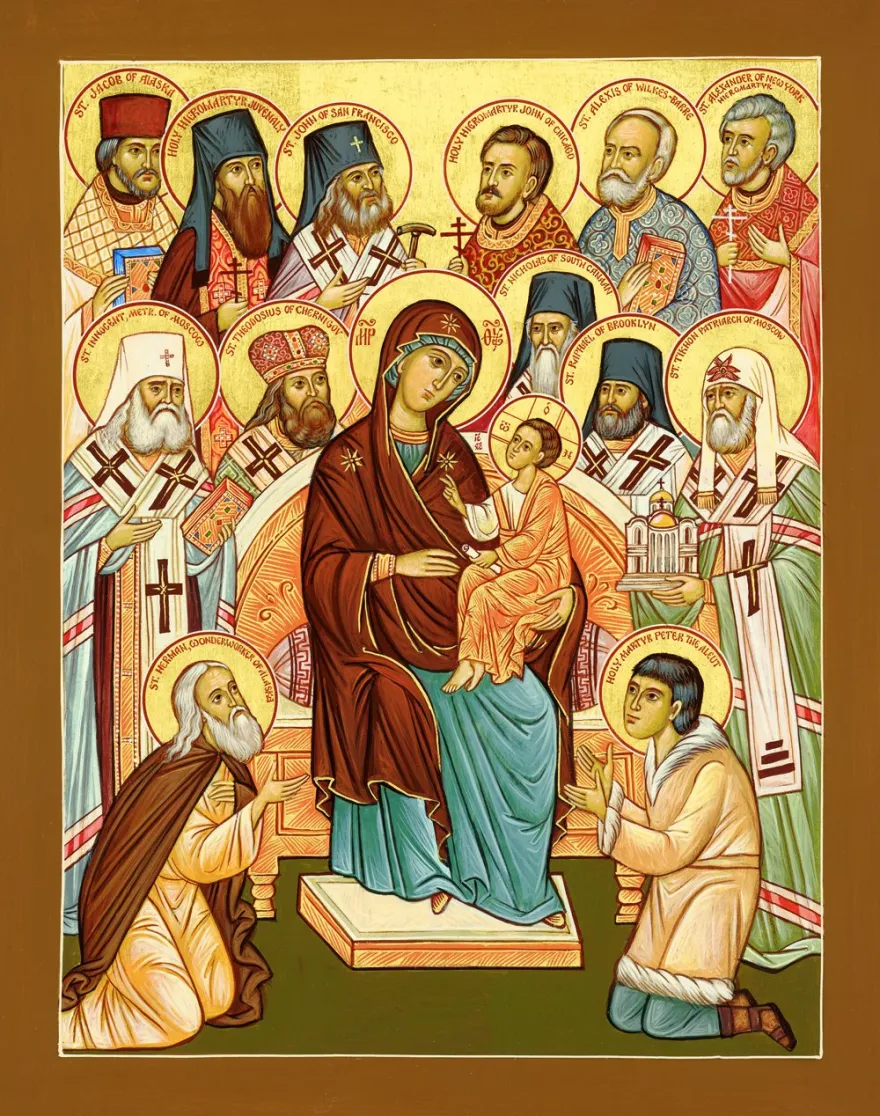
“Here as it was there” an encounter with sanctity. (a meditation on All Saints of North America)

The witness of Orthodoxy in North America is relatively young, especially compared to the witness of Orthodoxy for thousands of years in places like Greece, Romania, Ukraine and Russia. Indeed, the list of formally glorified saints in North America is truly pitiful when compared with the tens of thousands of saints in Russia, Ukraine or Greece! As such, the celebration of all Saints of North America, might seem, like a big deal about nothing. 

Yet, a saint is a saint, regardless of whether it was “here (the new world) as it was there (the old world)“. Their witness to the universal reality of God’s saving love is ultimately measured in terms of quality, not quantity – each one coming to the “unity of the faith and of the knowledge of the Son of God, to a perfect man, to the measure of the stature of the fullness of Christ” (Eph. 4:13). 

Instead of being isolated and unique, every saint imparts something universal – an encounter with sanctity – and as our Metropolitan Tikhon (Mollard) noted in a sermon on this feast, “by encountering sanctity, we encounter Christ”. This has been the witness of Orthodoxy in North America for the last two-hundred years (126 in Canada)  that has one way or another, brought us to this humble commemoration of what is essentially a only a handful of Saints. 

Each and every saint embodies the wholeness of the Lord’s saving dispensation, and bears witness to the same. This is a wonder! Even if our continent only had one saint, that solitary saint’s witness and sanctifying presence would lack nothing in importance or relevance when compared to the witness of tens of thousands of saints who for centuries served both God and neighbour, regardless of whether they were in Greece, Romania, Ukraine and Russia or even on an Alaskan shoreline, “for there is one God and one Mediator between God and men, the Man Christ Jesus” (1 Tim. 2:5). Yet more importantly, even a solitary saint, would have heard the very same words of the Lord, that each and every other saint heard, “Come, you blessed of My Father, inherit the kingdom prepared for you from the foundation of the world: for I was hungry and you gave Me food; I was thirsty and you gave Me drink; I was a stranger and you took Me in; I was naked and you clothed Me; I was sick and you visited Me; I was in prison and you came to Me.” (Mt. 25:34-36)

This is something profound to consider, especially as we are in these beautiful “green days” following the life-bearing outpouring of the Holy Spirit at Pentecost. It is in this Pentecostal context that we offer our thanksgiving to God for not one, but twenty-two North American saints. Although this number of saints is still a drop in the bucket in comparison to how many saints exist in the world, it is a start – but if we are being honest, the witness of the Lord’s saving love in places like Greece, Romania, Ukraine and Russia had to start with someone.

It is in these North American saints that we see the fullness of the faith as lived out in every element and aspect of their lives, as demonstrated in circumstances and situations that might seem totally alien to us, save for the fact we live on the same lands that they lived in. They served people around them in Alaska, the Midwest states and prairie provinces, and cultivated their faith through prayer and a Godly life. The blessing of our faith is that we believe they continue to serve us, and cultivate our faith – the fact that we serve in a Church that is almost as old as the witness of Orthodoxy in Canada, bears witness to this.

The challenge is for us is to follow their examples and patterns of holiness, and become a new generation of saints, sanctifying Narol, Winnipeg, Winkler, Morden, Manitoba, Canada and all of North America. By the grace of the Holy Spirit, and their many prayers, may we encounter the sanctity they encountered, and like them, encounter Christ. May we be inspired and strengthened in our witness of the wholeness of the Kingdom of Heaven, manifested “here as it was there” throughout the ages.

All Saints of North America, pray for us.

A photo of myself with the newly written Icon of the All Saints of North America, and the relics of St. Olga of Alaska, taken in the chancery office of the OCA in Springfield VA last fall.

The Gospel, All Saints of North America, and Residential Schools.

This past weekend we continued to bask in the glory and light of Pentecost beholding the outpouring of the Holy Spirit upon the Apostles and all humanity. It is in this “light and glory” that we see the abiding presence of the “Comforter and Spirit of Truth, who is everywhere and fills all things” in those holy men and women, who bore the fruit of the Holy Spirit, “love, joy, peace, longsuffering, kindness, goodness, faithfulness, gentleness and self-control. Against such there is no law”(Gal 5:22-23); the Saints.

To understand the importance of Pentecost, is to understand and give thanksgiving for the Saints. For this reason, the two Sundays following Pentecost are focused on the Saints; first in general (with All Saints) , and then more specifically, in specific (All Saints of Russia, Ukraine, Mount Athos, and in our case, North America). Those men and women, known and unknown who have borne the fruit of the Holy Spirit here on our continent, in our country, province, and even our Church.

Yet our remembrance of these blessed Saints who served us here, is done under the shadow of this county’s tragic and racist history towards the Indignious and Metis peoples. The media’s revelation of a long known understanding that more than 6000 children never returned from the Residential Schools they were forcibly taken to, has reached the tipping point challenging the notion of our Canadian identity, and even the validity of our Christian witness. Even if some involved were unaware of the evil effects of forced assimilation, or the generational trauma and harm done by these schools, the effect is the same. All churches are lumped together as evil.

To be sure, the perception that all “churches” are the same (and evil), and as such are responsible for residential schools in Canada is wrong. This crisis directly affects the Roman Catholic Church (predominantly) and to a lesser degree, the Anglican United, Presbyterian Churches of Canada, who worked in partnership with the government to “get rid of the Indian problem”(Duncan Campbell Scott, a leading architect in the Residential school program).

Yet we see the witness of the Saints, and especially those who laboured in North America whom we commemorate, standing in stark contrast to the goals of the Residential School program: run by churches, that polluted the pristine Gospel message of hope and victory, with the poison of western enlightenment and racial superiority.

Truly the Saints throughout all the ages, have changed the world because of the imperative to “Go, stand in the temple (or wherever country, or city or village throughout the world) and speak to the people all the words of this life”(Act. 5:20) and only that Life; He who is the “Way the Truth and the Life” (Jn. 14:6) Jesus Christ!

One only has to look at the enduring witness of Orthodoxy among Alaska’s Indigenous peoples to see this striking contrast. From the very beginning Orthodox missionaries in Alaska sought to witness the Gospel in the language of the people, and like a new Cyrill and Methodius, Saints like Innocent and Jacob and others, not only learnt the local dialects and languages, but created an alphabet and a written language for the Indigenous peoples they served. They translated parts of scripture, and services. They baptized the Indigenous understanding of the Cosmos, revealing the work of Father Son and Holy Spirit in them. So much so, that trying to delineate between pre-Christian and post Christian understanding of the Creation, redemption, and life is almost impossible for modern ethnographers.

It was the proclamation by these Missionary Saints in Alaska, of the Gospel and only the Gospel, that cultivated a vibrant Christian culture, that was more Aleut, or Tlingit, than it was Russian (even 150 years ago). It should be said that those same Saints also cultivated a vibrant Christian Culture that has become for many of us in the last 50 years more English, or French or Spanish than it is Russian, Ukranian, Romanian or Greek.

But we are not in Alaska, we are here, and there is terrible pain and suffering that compels us to act with the same kind of fervor as it compelled the Saints of this continent to act.

And this is the point.

Whereas we might not be directly responsible for the forced assimilation of the Ingignious and Metis peoples of Canada, and the misguided application of a flawed and polluted gospel; we nonetheless can not claim total innocence because we have not borne witness to the Gospel that baptized nations and cultures of Indigious peoples. Despite having a presence in Canada for over 100 years, there is no Orthodox Church that is more Anishinaabe, or Cree, or Nakota, Metis, (or any other nation ) than it is English or French.

Those Saints who shone forth in these lands, now point the way for us, in their love for God and neighbour alike. We might not be able to fix the wrongs of the past (especially as they were not our mistakes); but we can recognize them as being wrong and sinful, that is missing the mark of Christ, as revealed in the Gospel.

We can’t offer apologies, and gestures of reconciliation, that are empty sentiments and baseless words; Rather we, like the Saints, should offer our repentance (that is turn back to God) and offer our prayers, fasting, and works, in supplication for ourselves and these peoples. Bringing it all to the Lord

We shouldn’t hang onto history and tradition, as something that is of more value than the lives of a people and their culture. Rather, we should heed the witness of the Saints who would go so far as to “hate his father and mother, wife and children, brothers and sisters, (and even one’s own nation and culture) yes, and his own life also” (Lk. 14:25) in following Christ, and serving Him.

We can never condone any violence and vandalism in this tragedy, but we can seek to heal and understand the profound pain that has caused such a reaction, greeting it with the humility and love of the Saints, who bore all things for Christ, as the Lord bore all things for us.

We can not expect anyone else to solve this crisis, nor can we ignore our Mission as Christians because of this tragedy. We (Orthodox Christians) like the Saints, have to “make disciples of all the nations, baptizing them in the name of the Father and of the Son and of the Holy Spirit” (Mt. 28:19). Changing not the culture and life of a people, rather opening their hearts to life.

Like the Saints, we have to “speak the truth in love” (Eph. 4:13), even if it is hard for those around us to hear, even if it makes us look like fools. We have to speak of this tragedy, and we also have to speak of the only reconciliation that can happen between Indigenous peoples and everyone else; the reconciliation of our broken humanity with the Creator. That of God’s saving love, and only that love.

All Saints of North America, pray to God for us in the crisis of confusion and pain.