The word “today” is used numerous times by Christ in the Gospel to emphasize the imperative of the Lord’s work, actions and their consequences. Whether it is within His parables, or in the proclamation of His victory the use of the word “today” expresses a profound mystical reality, that at any particular moment in time (as experienced in seconds, minutes, hours, days, months or years) there is an encounter with the timeless and eternal presence of God. Yet there is a temptation that we can easily fall into that sees “today” as just a kind of spiritual time stamp that marks moments in history.
The problem with this understanding of “today” is that it conforms the work of the creator, to His creation (we see this over and over again anytime we get close to Christmas or Easter with silly articles that try to prove or disprove that Jesus existed). Its consequences reduce the scriptural witness to a bunch of moral stories that have to be proved or disproved, or even worse, it presents our faith as a dead letter as being impractical or disconnected from a created reality.
This all stands in stark contrast to the witness of Orthodoxy (and traditional sacramental Christianity) – that sees the imperative of this divine “today” as something that surpasses the history (and time) in its witness of God acting to save humanity. We see this beautifully presented and proclaimed in the feastal proclamation for the Annunciation of Gabriel to the Theotokos; “Today is the beginning of our Salvation.” (Troparion of the Annunciation)
It is in this feast that Gabriel brings the “good news” to Mary that she will bear the “Son of the Most High” who will “reign over the house of Jacob for ever; and of his kingdom there will be no end.” (Lk. 1:32,33). Indeed we witness THE moment in time and history – this “today” – that the eternal God, enters into humanity by assuming it in every way (yet without sin).
Its effect is a cosmic one, that changes everything. For with this feast, our mortal humanity is able to enter into the eternal moment of what is mystically celebrated; a divine and everlasting “today” – that has no past present or future. The timeless and eternal Lord of Glory’s seeks to encounter us for the very purpose, that the finite and created, might encounter the eternal and uncreated; and more than that, become partakers of that “divine nature” (2 Pet. 1:4). The challenge for us, is to see that the Annunciation’s “today”, and event that happened some 2000 years ago, is the same “today”, that the Lord reveals in His earthly ministry, and the same today as Saints encountered in their confession of faith, and the same today that each of us encounters at every moment.
If we have the eye of faith to accept and understand this all, His proclamation that “today”, the scriptures are fulfilled, is the healing of our broken hearts, and bodies now as then, at the beginning of His Galilean Ministry (Lk. 4:21). That in receiving the Lord “today”, salvation comes to our homes now as then, as it did for the repentant Zachaeus (Lk. 19:9). That having died in the waters of baptism and being raised with Him in newness of life, by the grace of the Holy Spirit “today”, we can be with the Lord in paradise now as then with the wise thief on the Cross (Lk. 23:43),
On the blessed and wondrous feast, there is no truer statement than this “today” as it is in every way “ the beginning of our Salvation.” For the Lord has been working, is working and will always be working to save humanity – to save you and me – regardless of whatever year, month, day or time it might be. By God’s grace, may our hearts embrace every moment, day, week, month, year, as that eternal “today” now, as then on that blessed and holy moment in time, when the Lord of Glory becomes incarnate for our salvation; and reveals in time, His everlasting and eternal love – “today”.
(This sermon was offered by Fr. Deacon John Schantz at the Sunday of Orthodoxy Vespers, served at St. Demetrios Greek Orthodox Church on Sunday March 9th 2025)
Fathers, brothers and sisters, Glory to Jesus Christ, Glory Forever!
This evening, we remember the conclusion of a battle which was waged in the church for over 100 years over icons. There is ancient testament to the presence of icons very early in the history of the church, but around the year 700, opposition started to mount to the use of icons in the church. Iconoclastic emperors arose who forbade the production and use of icons.
Our feast today commemorates the return of icons into the Great Church, in Constantinople in the year 843 – this time, iconoclasm came to end, at least in the church. Sadly, many icons were destroyed, and many people were persecuted, some even to death, for the making and using icons.
Since that time, the use of icons has been settled in the church. However, you may have noticed an increase of iconoclastic ideas from online characters who are again trotting out many of the same arguments which were brought against icon veneration in the past. Some decry the making of the icons, some the veneration of icons. None of the arguments are new and they have all been answered in the past by beloved saints such as John of Damascus and Theodore the Studite as well as the Fathers of the 7th Ecumenical Council.
One of the most dangerous ideas is that icons are quaint items that might have been useful as teaching tools in the past, but they are no longer needed because we have better ways of educating our flocks. Tied to this is the idea that they should not be venerated. This perspective misses that the icon is not simply a tool. The icon is a way that we show love, it is a way that we remain in communion with Christ and his saints.
A read through the John of Damascus’ defence of icons is recommended for anyone interested in the topic. But for the purpose of this talk, I wanted to point out that his writings are not simply a defense of icons, as a kind of appendix to the Christian faith. No, for John, the icon is not an optional extra; it is the proof of Christ’s saving work in humanity. And if we don’t have the icon, we don’t have the Gospel.
You see, Christianity has a problem. We speak of God as unknowable, inconceivable, indescribable, uncontainable. And if all these things are true, which they are, how do have a chance of “knowing” God in any meaningful way? The answer to this problem is the entire economy of salvation. Thankfully, as the Psalms attest, and as we sing in our services,“God is the Lord and has revealed Himself to us.”
John of Damascus asserts that the way God reveals Himself to us, is through imagery. We can’t see him or understand Him or define Him, but we can come to know something of God through imagery. In the language of John “Every image makes manifest and demonstrates something hidden…[images]…guide us to knowledge and make known what is hidden, for our profit and salvation.”
He gives examples of different kinds of images, including the Trinity imaged in the sun, its light and its rays, the mother of God imaged in the burning bush and Aaron’s budding rod, and the serpent on a pole imaging Christ’s overcoming of the primordial serpent. He also talks about images which God commanded Moses to make in the tabernacle: the cherubim, the bronze pomegranates, the images on the veils. Indeed, even the Tabernacle itself was an image of the Cosmos.
But even more importantly are the images of humanity, and that of Christ Himself. Humanity is made in the image of God, as we learn in Genesis chapter 1. We know that image was marred in the fall. Marred but not lost. However, Christ (the Logos of God) is not, in the image of God, He is the image of God. In Christ, the problem of God’s unknowability, His inconceivability, indescribability, uncontainability, are all answered. The God who cannot be seen and who cannot properly be named in the Old Testament, takes on a body, name and a face. Thus we can see him, we can call His name, we can paint his image!
At first glance, this seem to be at odds with the commandments. The commandment not to make images was because God could not be imaged. But in Christ, He is revealed to us. (Whoever has seen me has seen the Father). All this leads John to say:
I venerate the Creator… who came down to his creation without being lowered or weakened, that he might glorify my nature and bring about communion with the divine nature. I venerate together with the King and God…his body, not as a garment, nor as a fourth person (God forbid!), but as called to be and to have become unchangeably equal to God…For the nature of flesh did not become divinity, but as the Word became flesh immutably, remaining what it was, so also the flesh became the Word without losing what it was, being rather made equal to the Word hypostatically. Therefore I am emboldened to depict the invisible God, not as invisible, but as he became visible for our sake, by participation in flesh and blood.
John points out that he could have come as an angel, but he makes himself lower than the angels, and comes of the “seed of Abraham”. In so doing, He restores the marred image of God and raises our humanity to be in communion with the divine nature.
This is why, John points out, that we do not see images of humanity in the Old Testament, nor do we see Synagogues named after humans. Humanity was in a fallen state, prior to Christ, but in Christ, humanity has the chance to partake in the image of God. So the images are not simply images of people, but they also becomes images of God (yet another revelation of God) in some way.
This is why we make images. The icon is not, nor has it ever been primarily about information. It is about communion. It is about entering into relationship with Christ and, by extension, with all of the saints. Of course, we should also remember that John distinguishes worship from veneration and points out numerous examples in the Old Testament of veneration being offered to someone other than God. Jacob blesses Pharaoh and falls down before his brother Esau, and Daniel falls down before the angel of God, as but a few examples. So, veneration is proper and it is not possible to distinguish worship from veneration simply by observation, he points out that the purpose behind the act is what differentiates them.
Do we worship the wood and paint? No! he points out that we burn the wood when it is worn out. Instead he says, “We therefore venerate the images not by offering veneration to matter, but through them to those who are depicted in them.” “For the honour offered to the image mounts up to the archetype.” as the divine Basil says.”
So, we see that icons are not merely a quaint teaching tool. Icons are, in some way, the focal point of the Gospel itself. And this is what we celebrate today.
One word of caution should be offered here. It is easy to be triumphalist in that we have this beautiful theology of the icon, and this is something worth celebrating to be sure. However, we saw that the theology of the icon is firmly built on the foundation of humanity being in the image of God. In our triumphalism, it is important to remember that our veneration of the icon means nothing if we do not also venerate the human person who is in the image of God.
By this I do not mean to denigrate the icon, but I also want to remind us that we are in danger of denigrating the icon by our actions if we do not also venerate the image of God
In our family members In our brothers and sisters in Christ In the beggar we encounter on the streets In our co-workers In the person whose politics are opposed to our own
Simply put, the icon “doesn’t work” if we lose sight of the image of God in those around us.
By the prayers of the fathers of the Seventh Ecumenical Council, of St John of Damascus and St. Theodore the Studite and of all those who suffered for the making and veneration of icons, may we be able to see the image of God in all of the icons that He has provided for our benefit.
I was asked to give a “prepper” about the Liturgy of the Presanctified Gifts, for those who are not as familiar with this beautiful and unique service, that is only ever served in Great Lent, or might not a clue about what is done, and why it is done. Indeed if a person who only ever went to Church on a Sunday (or any time) but then showed up at a Presanctified Liturgy, they would be really confused. Why are people prostrating, going on their knees, Why is there so much silence and muted hymns?
Well a lot of this has to do with the general characteristic of Great Lent is somewhat penitential in context – especially on the weekdays when this service is offered (normally on Wednesdays and Fridays). Indeed, Great Lent is a season that highlights humanities fallen state. The work of fasting, prayer, and works of charity, which we are called to do, are meant to put aside those distractions that veil the problems of sin and death – it is a time were we like Adam and Eve, realise we are naked of any virtue and meaning. To emphasise this, the serving of Divine Liturgies on weekdays are prohibited, as the Divine Liturgy is festive and resurrectional, both in character and content (Liturgies are still served on Saturday and Sunday yet with reference to the work of the fast). This being said, there always existed in the Church an understanding that the Eucharist (the Body and Blood of the Lord), was a necessity in the work of bearing those fruits of repentance So what could be done that reflected penitential characteristic of Great Lent, and the importance of frequent common to realise this ?
The solution was to serve a Vespers with a few extra prayers, and commune the faithful from the gifts (the offered bread and wine) that was previously consecrated or sanctified at the previous Liturgy – thus the name “pre – sanctified”. This service is commonly attributed to St. Gregory I, Pope of Rome (also called the “dialogiest” because he wrote four dialogues about Church life). There are some disagreements about whether he composed it, or just recorded it while serving as the papal legate in Constantinople in the early 7th century – yet it really doesn’t matter because the important thing is that, in this service, there was a way in which the faithful could participate in the Eucharistic life of the Church, and be strengthened and inspired in their fasting, prayer and acts of charity.
Some might wonder if this service was a way of “getting around the rule” of not having a Divine Liturgies on weekdays… Well, if the Church really wanted to have a Liturgy during the week, they would have made it happen – rather than beat around the bush. Instead, this service is an expression that the Euchrist is a vital element in our ability to fast, pray and offer works of charity – as such the Presanctified Liturgy is a beautiful accommodation that respects the penitential character of this season, while at the same time respecting that we need to participate in the Eucharist to assist us in this difficult journey – and it is/should be difficult. What is remarkable, is that this particular service in many respects is a snapshot of our Lenten labours and struggles. The colours are dark, hymns are penitential, the music is as mournful as our realisation that we are sinful, broken, and mortal people. Yet (and it is big “Yet”) in the midst of it all, there is the very real sacramental presence of the Lord Himself – His Body and His Blood – that conveys life itself to the faithful, even as we are stretching to understand and live it through our fasting, prayers, and works of charity.
This sacramental presence, of the Body and Blood of the Lord, in the consecrated bread and wine, at this service, indeed shapes how we ought to act during the service. For the first few weeks of Great Lent, I generally serve with the royal doors of the Iconostas open, so that the faithful can see (as best as they can) how reverently the priests, deacons and servers conduct themselves during the service. The prostrations, the slow methodical movements, censings, set the standard of how we should react to such a profound mystery.
During the singing of the beautiful hymn of “Let my prayer arise…” ( Ps. 141) it is the tradition that the faithful (like the clergy in the sanctuary) lower themselves to their knees (in some Churches, they even prostrate). This hymn is followed by the prayer of St. Ephraim which is the prayer par excellence of Great Lent, where, following every verse, we do a full prostration (fall down on all fours, with head to the floor). After the first Old Testament reading, the second prokeminon is sung, and then the priest turns and stands towards the faithful with a candle and censer in hand and intones “the Light of Christ, Ilumens all” –
At this, the faithful again do a full prostration; a response to the principle that we can only understand all of the Old Testament, and indeed these lenten labours, through Him who is the Light (Jn. 8:12). After the readings and some prayers, there is the Great Entrance, where the Body and Blood of the Lord are processed to the Altar. This is of great solemnity, where no one has their back to the gifts (even the servers, and deacons walk backwards, always facing the priest who carries the gifts). This is done in silence, with no commemorations, and everyone fully prostrates in awe, that “Now the Powers of Heaven invisibly with us do serve. Lo, the King of glory enters. Lo, the mystical sacrifice is upborne, fulfilled” (the hymn of the entrance). Following this, there is again, the prayer of St. Ephraim is said, with the appropriate prostrations.
Please know that I more than realise that there are some people who might be able to go down to be on their knees, or to make a prostration – yet can’t get up! There might be some who are stuck in pews – where making a prostration is really impractical; or they are some who feel really uncomfortable with kneeling, or doing a prostration, as they don’t understand it. This is all more than understandable. As such, a deep bow, or a revernace (bowing the head) is more than sufficient in recognizing that something special is happening.
Indeed something special and miraculous is happening! The involvement of our body through kneeling and prostrations truly reflects this and reveals that all this is very real, and not just a mental exercise. For the Lord is acting to save us, He is acting to feed us. If we can see and physically respond to what is offered and expressed in the Presanctified Liturgy, then we have a better chance to see that our fasting, praying and offering acts of charity are meant to be very real – something more than a mental exercise.
By the prayers and intercessions of St. Gregory Dialogos, Pope of Rome, may we be strengthened in our lenten journey as a people who think, feel and do, and not just think and feel.
The Pharisee and the Publican, woodcut by Hans Holbein the Younger
This Sunday we officially begin a new liturgical cycle called the Triodion (Τριώδιον) – which literally means “three odes” sung at Matins, the de-facto name of this cycle and journey to Pascha. Although Great Lent starts on March 3rd, we are given the four preceding Sundays as a kind of orientation, preparing us the fast itself.
Through scripture, and hymns and writings, we are given examples of repentance, restoration, hope and love (the publican, the prodigal son’s Father, those who serve the Lord, and those who forgive); and examples of pride, rejection, greed and indifference (the pharisee, the prodigal son’s poverty, those who don’t serve the Lord, and hypocrites empty reward); so that we might recognise what is of God and His love for us; and what is of our own brokenness and sin.
The hope is that in recognising what is of God – and what is not, we might fully understand and know what it is that the Lord is offering us; and make the informed decision of what it is that we will strive to do, and what examples we will try to emulate, throughout those 40 days of the fast.
For the Lord has “set before you life and death, blessing and cursing; therefore choose life, that both you and your descendants may live, that you may love the Lord your God, that you may obey His voice, and that you may cling to Him, for He is your life and the length of your days” (Det. 30:18-20)
Truly we are asked not to make just “an” informed decision – which could be applied to knowing what kind of soap to buy – but rather “the“ informed decision, which definitively cuts to the heart of what it is to be human. By God’s grace and love, may the eyes of our hearts be open, to make the informed decision, and follow Him and live. Not just today, or through Great Lent, but in every moment of our lives.
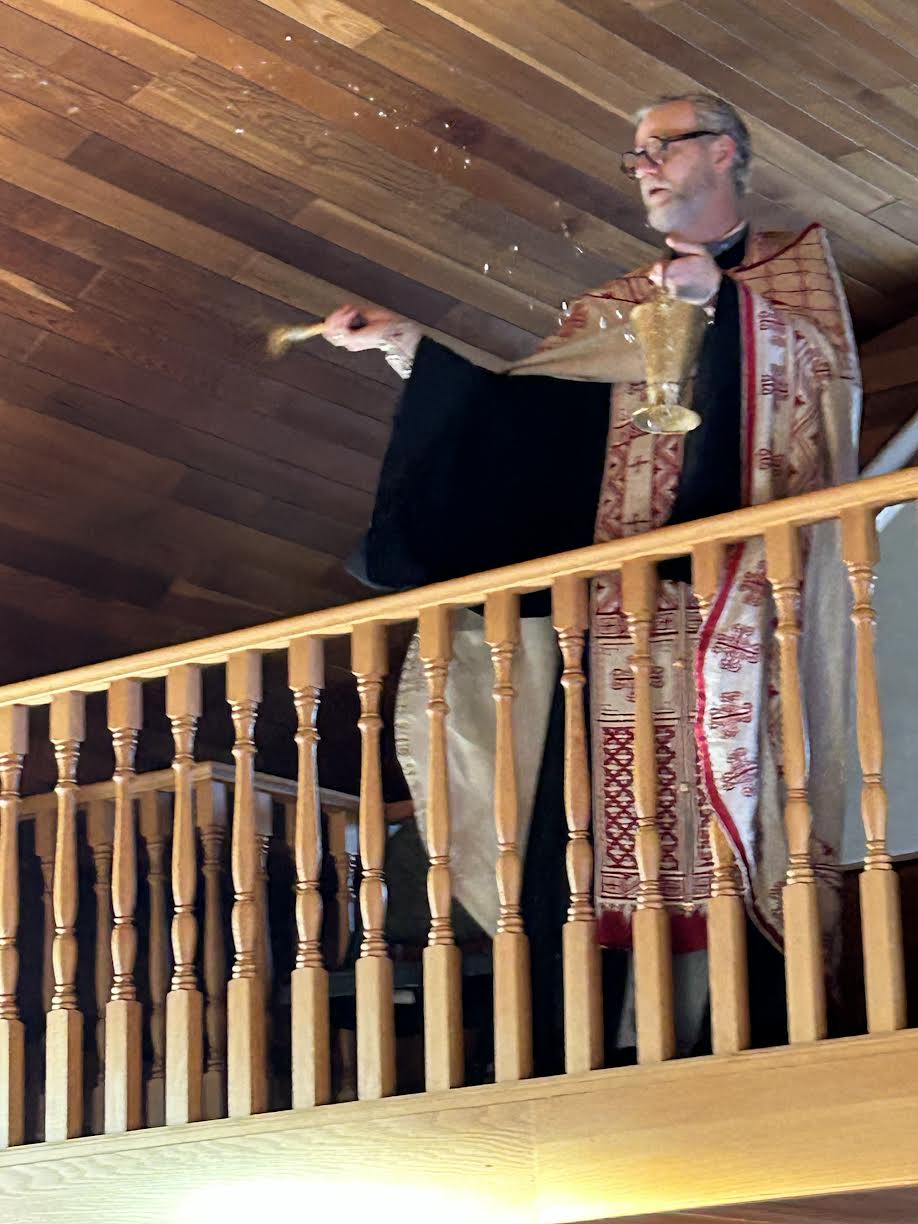
I am profoundly thankful to the Lord that I serve in a truly beautiful Church, in a beautiful part of this country. More often than not, I find myself thinking, that there isn’t really anything better than when our brass candle stands and chandelier gleam, the golden brown cedar of the interior of our temple, glows and the colours in our Icons captivate. Indeed I don’t there isn’t anything more moving then the snow covered windswept fields, that surround our Church, shine like a pristine sheet, or the open prairie skies that are a witness of God’s glory… Well that is until we serve the Great Blessing of the Waters, for the feast of Theophany.
At this feast, with the Great the blessing of the waters, when priests and deacons process around the Church, lake or river and sprinkle (more like splash) the people and everything with the newly blessed waters; all those many beautiful things remarkably – and beyond belief – seem even more beautiful. The brass candle stands, and chandelier don’t just gleam – they radiate. The golden brown cedar of our temple doesn’t just glow – it warms our hearts. The colourful Icons don’t just captivate – they enthral. Those snow covered windswept fields don’t just shine – they dazzle like diamonds, and the prairie sky doesn’t just witness God’s glory – it proclaims His mighty handiwork.
Please know that this isn’t necessarily me being emotional (which truthfully I can be), rather it is a perspective, in which something greater is revealed- that these beautiful elements which normally serve a wonderful function, or are part of a beautiful landscape impart something greater, as they manifest the Lord’s saving love for us.
It is important for us to understand that these things, like all creation were casualties of humanity’s fall, being put under the “bondage of corruption” (Rm. 8:21) and reduced to being finite tools or fleeting moments – and not the revelation of eternal blessings. Yet in the Lord’s love, He condescends to be submersed in the waters of the Jordan, and through Him all creation is brought up with Him, being delivered “into the glorious liberty of the children of God” (Rm. 8:21). This of course isn’t for the sake of creation independently, but rather for us.
The wonder we see in this feast and service, is that the Lord offers all humanity this revelation as part of His saving work. It is to be understood as being much more than a mental or spiritual exercise, but also as a sensory and physical experience, beheld and participated in, through the eyes of faith. For He hastens to descend into the depths, “bowing down to his own servant, that he might lift humanity up to the heights having freed us from bondage” (Great Blessing of the waters); opening “a pathway for all flesh to the resurrection from the dead” (St. Basil’s Liturgy) mystically through our baptism into Himself, in those same waters.
It is in this context that we should consider the fact that, if the darkness and corruption of our fallen humanity is enlivened and renewed in the Lord’s baptism – a baptism that we participate in by “putting on Christ” (Gal. 3:27) – then it stands to reason that everything else is also renewed, as having the vocation of witnessing the Lord’s saving plan- including those many beautiful things that we use and that surround us.
For in this feast and service, those brass candle stands, and that chandelier doesn’t just gleam – they truly radiate with a light that seems piercing. The golden brown cedar doesn’t just glow – it truly warms our hearts, greater than the most blazing fire. Those colourful Icons don’t just captivate – they truly enthral, cutting to the soul of the viewer. Those snow covered windswept fields don’t just shine – they truly dazzle like diamonds of the most glorious wedding garment; and that prairie sky doesn’t just witness God’s glory – it truly proclaims His mighty handiwork, that stretches as far as the east is from the west- for our salvation . Really it isn’t me just being emotional; rather it is a perspective, in which something greater is revealed for us to participate in – the total love of God for us, experienced even in creation.
May we have this perspective, not just in this radiant and beautiful season, but throughout our whole life!
Last week’s ordinations of Protodeacon Edward Jordan to the priesthood and the reader David Pasivirta to the diaconate in Calgary was truly remarkable in so many ways; yet nothing new, in that they were the continuation of a beautiful pattern of ordinations that have marked the life of our blessed Archdiocese – especially in the last few years (including our own Dn. Greg, and Dn. John).
Any ordination is wonderful! Indeed a profound blessing that strengthens the Church’s proclamation of the Lord’s saving love, and verifies His abiding presence, even if there are only “two or three” gathered together in His name (Mt. 18:20). What is interesting, is that the majority of these men and their families were quite content in doing what they were doing – serving God and neighbour alike in serving their communities and even the Church as a whole; humbly with no other motive than to be Christians.
The Gospel that was read for Fr. Edward and Dn. David’s ordination (Luke 14:1-1) provided a context that qualified their (and others) ordination. In the second part of this Gospel, the Lord offers a parable that contrasts the expectations of honour and authority, with demonstration of humility.
“…When you are invited by anyone to a wedding feast, do not sit down in the best place, lest one more honorable than you be invited by him; and he who invited you and him come and say to you, ‘Give place to this man,’ and then you begin with shame to take the lowest place. But when you are invited, go and sit down in the lowest place, so that when he who invited you comes he may say to you, ‘Friend, go up higher.’ Then you will have glory in the presence of those who sit at the table with you. For whoever exalts himself will be humbled, and he who humbles himself will be exalted.”
The paradox is that those who would normally be honoured as having or wanting authority, are the ones who end up bearing the shame of exalting themselves; yet those who humbly recognise that they have no authority, let alone honour, that end up being glorified, “for whoever exalts himself will be humbled, and he who humbles himself will be exalted.”
Although I don’t know everyone who has been ordained in the last year or so, I do know more than a few of them. In these cases, I have never observed the desire for honour or authority, or the expectation that they could better serve the Lord by being ordained. Rather, these men and their families (like Fr. Edward, and Dn. David and others) have only ever sought to serve, and serve, and serve the Lord and His Church, as labourers, council members, deacons, choir directors, camp counselors, friends, doctors, and teachers. Although their contributions were (and are) profoundly important, there always was (and is) a willingness to defer to the honour and authority, of those whom they serve, with no expectations of doing bigger and better things. .
To be honest, if I told Fr. Edward, Dn. David, Fr. Gregory Wright or Theodore Matson (St. Herman’s in Langley BC) a year ago – that they would be ordained this December, they would have thought I was crazy. Or to put it in the context of the Gospel read at the ordination – if they were told that they were to occupy the “best places”at the wedding feast, that it our Divine Liturgy, they would have thought a huge mistake was made. For they all humbly recognised the honour and graciousness of occupying even the “lowest place”at this feast!
I can think of no better gift in which to be set aside and consecrated – for it is nothing less than the love of God and neighbour (Jn. 15:12-13). I can think of no better quality in which to be honoured and exalted – for it is nothing less than the desire to serve rather than be served (Mk. 10:45). I can think of no offering better leaders in which to bear witness to the saving work of the Lord – for it is nothing more than what the Lord does for all humanity (Mt. 19:28-30).
It is something to consider that these ordinations share the very same content of Christmas, as manifested in the humility and condescension of the Lord. It is humility – rather than honour or authority – that reveals the Lord’s love; through these gifts, qualities and its witness. For it is the Lord who willingly takes “the lowest place” in “taking the form of a bondservant, and coming in the likeness of men.” And in His boundless love, He voluntarily takes on humanity’s shame, dishonour (not honour), and disdain (not exaltation) going even lower, “being found in appearance as a manbecameobedient to the point of death, even the death of the cross”. It is this humility that is the context for His glory and honour, as “God also has highly exalted Him and given Him the name which is above every name” (Phip. 2:6-9).The wonder is that this honour and authority is bestowed upon us by the grace of the Holy Spirit – elevating us to the “best spaces” sharing in His divine life as “a royal priesthood, a holy nation, His own special people” (1 Pet. 2:9)
This season (as does all scripture) sets forth the template and standard for our life in Christ – and especially for those who are called to serve Him, in serving the Church, the Body of Christ. The ordination of Fr. Edward, and Dn. David, and all those new deacons and priests (including our blessed deacons at St. Nicholas) is the revelation of what God is doing for us – as witnessed in their humility and desire to do nothing less than to serve God and neighbour alike.
May the Lord open our hearts, that we might see the lengths that the Lord goes to save us, in his humble nativity; and see the humility of Fr. Edward and Dn. David as revealed in their ordinations. So that we might truly be exalted and saved in that divine love and by that “grace divine which always heals that which is infirmed, and completes that which is lacking…” and which elevates those who humble themselves, to find the love of God even in those “lowest places”.
May the Lord grant the newly ordained Fr. Edward, Matushka Victoria, and the Dn. David and Diakonisa Lauren – and their families many blessed years!
Every year, the celebration of St. Nicholas’ feast day (Dec. 6th) seems more glorious than any preceding year (and we have been doing this for a while). This is all for good reason, as the Lord has blessed our parish with such a loving intercessor in His Holy Bishop Nicholas. Indeed it is through the prayers of St. Nicholas that the Lord’s saving grace and mercy has been declared. It is through his prayers, that the joy of being loved by the Lord has been imparted; and by his prayers that the beauty of the Lord’s radiance and splendour has been manifested. What is truly wonderful, is that our parish faithful have been active participants in these blessings, rather than passive recipients.
The Vespers, feast and Liturgy for St. Nicholas that we celebrated just a few days ago, was indeed the offering of our best talents and gifts. For it was a witness of the Lord’s saving grace and mercy – serving the Lord, in serving each other. It was a witness of the joy of being loved by the Lord – in the laughing and enthusiasm with friends and strangers alike. It was a witness of the Lord’s radiance and splendour – in the beautiful music, and glow of a candlelit Church. What is more glorious than this? Well if we listen to what St. Paul has to say, there is indeed something more glorious than all of this, as he states “earnestly desire the best gifts. And yet I show you a more excellent way”. (1 Cor. 12:31).
This “more excellent way” that St. Paul offers, is that of boundless “love” that is not finite or limited; for the more one realises they are loved, the more one can love; and the more one can love, the more one realises that they are loved.
St. Nicholas’ revelation of God’s saving love for our parish, and our parish’s service, rejoicing, and radiating of these blessings, is the context for that “more excellent way” stretching even into the Kingdom of Heaven from the here and now of our little parish!
In all of this, I truly Thank God for all those who worked to prepare, facilitate and participate in this blessed feast- from the amazing singing reading and directing, stunning and shining brass and Church, the Litya loaves, the serving, the sermon and kind words; the hospitality, amazing food and clean up; the bags of treasure (treats) that Santa himself gave out! Truly I can think of no better time to begin a “more excellent way” .
Most Holy Bishop Nicholas, pray for us in this all!
Serving with us for our parish feast (Left to Right) Dn. Ioann Boiskho (Holy Trinity Sobor, Winnipeg) Pr. Stephen Sharman, Dn. Gregory Wiebe, Archpriest Serhii Kashyrets, Dn. John Shantz, Archpriest Gregory Scratch, Priest Matthew Beynon (Holy Trinity Sobor, Winnipeg) Priest Yuri Hladio – who gave the sermon (St. Maria of Paris- Hamilton ON)
As we begin the 40 day fast leading to Christmas (Advent), it is helpful to remind ourselves of the reason we fast. It is not self mortification, or a kind of penance, in fact it isn’t anything negative or sorrowful (although it might feel like that). On the contrary, the call to fast is ultimately joyfully positive in its application and goal.
The call to fast at certain times of the year, presents us the opportunity to broaden our perspective by exercising a degree of restraint with those things we eat, and those things we do; yet the temptation to forget the reasons we fast, can have the opposite effect, and narrow our perspective – both with God and neighbour alike.
If one could summarise the whole practice of fasting (as understood in the Orthodox Church) it would be the call for us to put aside our normal wants, and desires (for a time) that we can see something more than ourselves as being the centre of everything. The intended effect of this work (and it is work!) is that we see those around us not simply as the “others” whose struggles don’t have anything to do with us; but rather as people just like you and me, whose struggles to get through the day, week, season or years, are not unlike our struggles (in either principle or actuality). What is presented is that those “others” are people just like you and me, seeking the same kinds of things we seek – hope and deliverance – from the challenges, labours, and sorrows of life. I suppose a glib or negative way of looking at this is that “misery loves company”, yet our faith calls us to consider that no one is alone in carrying the burdens and tragedies of life; not even the Lord Himself – for God in his mercy and love for humanity, “made Himself of no reputation, taking the form of a bondservant, and coming in the likeness of men. And being found in appearance as a man, He humbled Himself and became obedient to the point of death, even the death of the cross.” (Phil. 2:8,9). It is in this that there is an even greater revelation that our fasting reveals.
In looking beyond ourselves, we recognise the struggles of those around us, as being our struggles; and in this we see that with greater clarity the love of God who takes on these struggles for us, reconciling them all in His saving victory and abiding presence. This is the perspective that compels us to look beyond ourselves, so that we can offer and serve those around us as brothers and sisters, because “even the Son of Man did not come to be served, but to serve, and to give His life a ransom for many.” (Mk. 10:45). Truly this is a “hope that does not disappoint” (Rm. 5:5), and a deliverance from the bondage of sin and death that all humanity seeks. This is nothing short of a wonder. For we not only can behold the hope and deliverance that the Lord manifests, but also participate in it – Revealed mystically in our fasting as we journey to Bethlehem, and the timelessly feast that is the Nativity in the Flesh of our Lord God and Saviour Jesus Christ.
We fast from certain foods (as best as we can) and behaviours, not simply because “we have to”; but because with joy, we seek to clear away those distractions that inhibit the eyes of our hearts from beholding a God who comes to us identifying Himself with those who are hungry, thirsty, sick, naked and in prison (Mt. 25:36-44). We offer charity and alms not simply because “people need help”; but because, the Lord in seeing our necessity, acts out of love for us in becoming like us in every way except sin, that we might by the grace of the Holy Spirit cry out “Abba, Father” (Rm. 8:15).
Advent (and any fast) is meant to be a joyful anticipation in that hope that we and those around us have in “His calling”, bestowing upon all humanity “the riches of the glory of His inheritance in the saints” (Eph. 1:18). Advent (and any fast) is meant to be a joyful participation in the deliverance“from the bondage of corruption into the glorious liberty of the children of God” (Rm. 8:21)
May we have the eyes of faith to see in this season of fasting something greater than ourselves and our needs – to see those around us, and to see the Lord’s love for them and us. In this season of fasting, may we have the strength to act and in serving those around us, as the Lord is continually serving us, out of His unending and boundless love.
How could any fast (let alone this Advent fast) that reveals these things, not be understood as anything less than joyful and positive in its application and goal.
As I was leaving Church after the liturgy for Transfiguration (Aug. 7th), I noticed that a car had parked on the road, and that a young couple were walking towards the Church. I welcomed them and asked if I could help them. Well, this young couple were just on their way back home to Regina from their honeymoon(!) and wanted to check out St. Nicholas. Brendan Olenick (who happens to be a real estate photographer) and his wife Bryann, like to tramp around and video old prairie Churches (just like ours) and document them for his Youtube channel (Awesome prairie Churches). Both Brenden and Bryann attend St. George’s Romanian Orthodox Church in Regina (where they were married just the past week), and as we talked we soon realized we know many of the same people, and have visited many of the same places (even been together at a service without realizing it).
I have to say that at first I was a little sheepish about them filming the Church, as I would have liked to have lit candles and put flowers on the tetrapod and cleaned up a bit. But as we entered the nave, I realized that I didn’t really need to fuss about it, as it really didn’t matter. Even though the Church was empty and silent, it nonetheless radiated the same kind of beauty and warmth that it radiates when it is full of people and is noisy with the giggles of children, singing, and censers clanging. Wow!
Thankfully, I think that Brendan’s video (including his drone footage) captures this beautifully.
You can find the video of St. Nicholas on his Youtube page or Facebook page, and I encourage everyone to see the wonderful work both he and Bryann have done.
A few weeks ago the parish of Holy Resurrection (ROCOR) received the shoe/slipper of St Spyridon of Trimithus, brought to Winnipeg by with the blessing of the bishop in Corfu Greece. After making a suitable place in the church for this holy object (святыня) and commissioning an icon of St Spyridon, they have graciously invited the greater Orthodox community of Winnipeg to join them in their veneration of this wonderful Saint and his relics.
This is truly something wonderful, and it offers us an opportunity to engage with the Saint in a very real way, as we stand before his relics. This also offers us an opportunity to understand in a greater way what relics are, and the significance of their presence.
In short, relics are portions of the earthly remains of saints, objects connected to them, or articles that have been placed on the body of the saint. Their veneration which stretches from the Old Testament (2 Kings 13:20–21) through to the earliest days of the Apostolic Church, and beyond, has always been a affirmation of the fact that “matter, matters”. For the context that was understood in Israel and the early Church, was that “The earth is the Lord’s, and all its fullness, The world and those who dwell therein” (Ps. 24:1 / 1 Cor. 10:26); that in the light of the Incarnation, and outpouring of the Holy Spirit, reveals creation (matter) as a means to encounter both physically and spiritually, God’s saving love. The Saints bear witness to this life which reveals “new heavens and a new earth” (Is. 65:17), for if “Christ is in you, the body is dead because of sin, but the Spirit is life because of righteousness” (Rm. 8:10)
As St. Cyril of Jerusalem says “Though the soul is not present a power resides in the bodies of the saints because of the righteous soul which has for so many years dwelt in it, or used it as its minister.”
( (Catechetical Lectures -18:16).
Throughout the history of the Church, relics were seen to be – just relics, regardless of what they were. Yet there developed in Western Christendom a ranking of relics, that although was a foreign concept for Orthodoxy, nonetheless came to define them. First class relics were understood to be portions of a saint’s body, that have been divided and distributed (or the wood of the Cross). Second class relics were understood to be those possessions, or objects that were used by the saints, or were part of their story (like the chains of St. Peter). Third class relics were understood to be articles (namely sections of cloth) that have been placed on the Saint’s body.
This codification was partially a way that the Church could verify relics (and prohibit counterfeits – as such most relics have certificates that authenticate them – but not all) and express that it was in the context of the Church that the sanctity and life of the Saint was consistent with scriptural witness and tradition that the Saint lived in. To be sure it is not like the Church has a copyright on the relics or anything like that when it comes to relics, yet it nonetheless highlights the Church’s role in the consent, direction and distribution of relics.
The challenge with this understanding is, that in quantifying these holy articles, there can be a temptation to also quantify their importance and efficacy; or to put it plainly; to define (and thus limit) the grace that those relics denote. This of course flies in the face of not only the witness of our faith, but more importantly the witness of Scripture.
I suppose one could say that bodily relics of an Apostle (defined as first class relics) might be more effective as a witness of God’s saving work, than a piece of cloth that was placed on them (defined as third class relics). Yet it was something like a piece of cloth “handkerchiefs and aprons that were carried away from his body (St. Paul’s) to the sick, and diseases left them and the evil spirits came out of them.” (Act. 19:11-12). Even the shadow of St. Peter was a witness of God’s saving work (Act. 5:15-16) – I’m not sure there is a class for that.
This is to say that we ought to be careful that we don’t get carried away thinking that some relics are more important than others, or that some bear more grace than others; because what is important for us to understand, is that regardless of what class the Saint’s relic might be, it testifies to the fact that there were men and women, whose lives were transformed by the grace of the Holy Spirit. That in taking up their cross and following Christ (Mk. 10:21) they became a “new creation” (2 Cor 5:17/Gal. 6:15) 6:15) that transcends even death.
The slipper of St. Spyridon that is at Holy Resurrection (regardless of what class of relic it might be) offers this witness. For there was a man named Spyridon born some 1700 years ago in Cyprus. He was a humble shepherd and then compassionate and loving bishop. He gave his life to the Lord in everything, manifesting His divine and saving love. He died, yet nonetheless continued to offer his intercessions and witness to the people of Cyprus, and then to the people in Constantinople and then to the people of Corfu, and then to the people of the whole world (including Winnipeg).
The fact we get to consider the reality of this revelation of God’s mercy and grace, is an affirmation of what God has done in saving His servant Spyridon, and what God is doing as He works to save us. By the prayers and intercessions of the Lord’s faithful and loving servant, may we all be saints!
A Moleben (supplication service) and Akathist for St. Spyridon will be served this Monday (September 30 at 7:00pm) with light refreshments to follow.