Blog

  • Unity and life -a “prairie Pascha” (reflection on the 50th anniversary of Holy Resurrection in Saskatoon, and the ordination of Fr. Johnathan Goosens, and Dn. Edwin Hay)

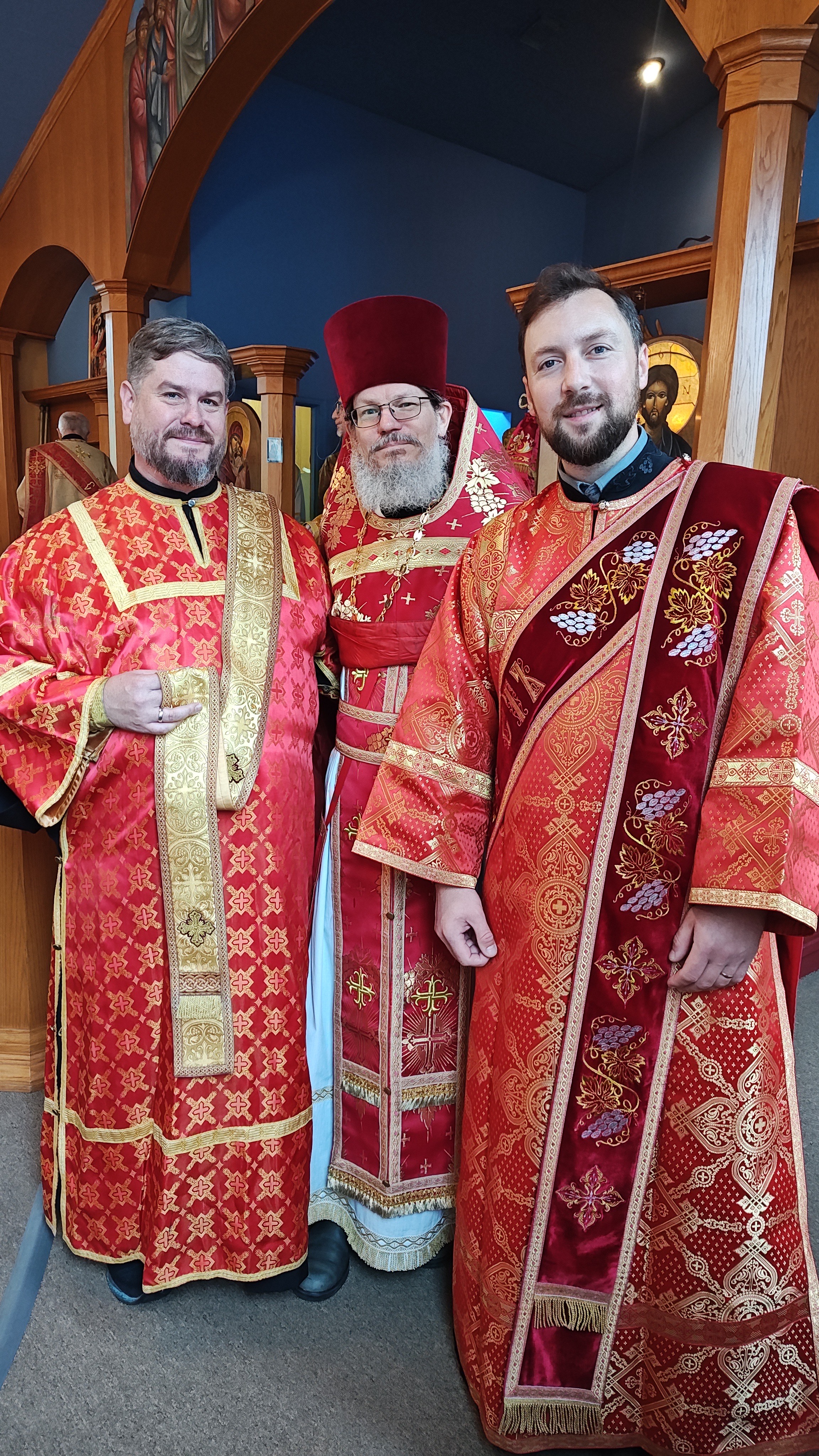
    As many of you know, last weekend I was in Saskatoon at the parish of Holy Resurrection. The wonder is that what I witnessed and participated in, was that of the unity and life of our Church.

    The very fact that we were celebrating the 50th anniversary of Holy Resurrection, a community that had very humble beginnings (not unlike many other communities in our Archdiocese, including our own), and that we were present to shout “Axios” (worthy) for the ordination of Dn. Johnathan Goosens to the priesthood, and our own (by extension) Subdeacon Edwin (Cam) Hay to the diaconate, was truly amazing enough. Yet, there was something even more amazing than this.

    Surrounding our beloved Archbishop Irénée were 11 priests and 9 deacons, (from Manitoba to BC) and about a hundred faithful, all offering our thanksgiving to God for what He has done, and what He is doing. Truly this speaks volumes to the indwelling presence of the Holy Spirit in our Church, and the unity of our faith.

    Fr. Matthew Francis (Holy Apostles Mission in Chilliwack BC) described the weekend as being something like a “prairie Pascha”! No words could be truer. Indeed at Pascha, there is an unparalleled sense of unity and even a kind of closeness that sees no one as being a stranger, having experienced and participated in the Lord’s joyful and radiant victory over sin and death. This brings to mind the verse from the Paschal canon which beautifully exemplifies this, “let us call brothers (and sisters) even those who hate us, and forgive all by the resurrection, and so let us cry, Christ is risen from the dead, trampling down death by death, and upon those in the tombs bestowing life.”

    This victory lavished upon all humanity in the Lord’s saving Pascha, is an event that should permeate every moment of our lives (especially when we celebrate the divine liturgy, a “little Pascha”). For the Lord in His love and work for us, has brought into harmony the discordance of our broken and individual lives, and by effect brings us in harmony with our family, friends, strangers and even enemies. Although I did not know some of the clergy or faithful there: I was as close to them as if they were indeed my own brothers and sisters. Although I might had had disagreements with some of clergy and faithful: we were in perfect accord. Although I hadn’t seen some of the clergy and faithful in years: I was as close to them, as if they lived next door. Truly it was paschal in every way. 

    Of course we all had to go our own way back to our own lives, homes and parishes. Yet beyond the celebration of an amazing and miraculous 50 years, and the ordination of a priest and deacon, what was experienced, was that which is at the heart of our life as Christians – the proclamation of Gospel and the Lord’s saving work for humanity, and our unity with and in the Lord and His faithful, being members of His Body, the Church – regardless of where we came from, what we do, or even if it wasn’t Pascha. 

    May the Lord grant us the eyes of faith to see this Paschal unity and life in even the most isolated and lonely movements of our lives; regardless of where we are, or day or season it might be! And may the Lord grant many years to the clergy and faithful of Holy Resurrection in Saskatoon, and to the newly ordained priest Johnathan , and deacon Edwin, and their family’s!

    Christ is Risen! Indeed He is Risen!

  • The Nativity of the Theotokos – The context of salvation.

    This week  we celebrate the first feast of the Church year, the Nativity of the Theotokos. Although this  is not a scriptural feast (Like the Annunciation) it nonetheless has been woven into the spiritual and liturgical life of the Church for many centuries. Indeed this can be a challenge for many people trying to understand Orthodox Christianity as it gives the impression that we are adding stuff to the Gospel, or that  the scriptures are not enough. Yet if we scratch the surface of a feast like the Nativity of the Theotokos, we see that everything about Mary, is about her son Jesus, and the witness of the Lord’s saving love as revealed in holy scripture… or to quote Fr. Thomas Hopko ” The Gospel is not about Mary, but Mary is certainly about the Gospel!” 

    In all those feasts that are dedicated to her, what is brought to our attention is the whole economy (working out) of salvation. Her being conceived by Joachim and Anna (which we are celebrating), her nativity, her entrance into the temple (Nov. 21st), her conception of our Lord God and Saviour Jesus Christ at the Annunciation of Gabriel (March 25th), and her Dormiton (Aug. 15th), speak with clarity about the love of God for His creation, and the length He goes to save us; “who, being in the form of God, did not consider it robbery to be equal with God, but made Himself of no reputation, taking the form of a bondservant, and coming in the likeness of men”(Phil. 2:6-7).   

    The through line of all that is celebrated those feast days that focus on her, is the principle that the Lord’s saving work was never demonstrated  in a vacuum.

     It started with Israel’s covenant with the Lord, and the struggles to follow Him as witnessed by the holy men and women who clung to the Law, the Psalms, and the Prophets. This struggle continued with the righteous Joachim and Anna, who in faith conceived, and brought forth a child in their barren old age -Mary – who in the fullness of time brought forth her son and our saviour, Jesus Christ. Emanuel, God with us!  

    In the same way that the Lord worked with humanity, and through history, He continues to work with us; here and now. What was accomplished by the Old Testament those many prophets, kings, men and women like Joachim and Anna, who although  “having obtained a good testimony through faith, did not receive the promise” God having provided something better for us,” (Heb. 11:39,40) is now accomplished by us through the grace of the Holy Spirit “poured into our hearts” (Rm. 5:5). For if the Lord  in His love for Humanity, did not act independently or arbitrarily in His saving work in those days of old, why would he do it now?  

    This feast of the most holy Theotokos’ nativity is the perfection of a promise to redeem Israel and all humanity, manifested not in some awesome demonstration of divine power that would put most amazing CGI to shame, but in the most basic and natural way; through people willing to trust in the Lord, through a family. 

    Although not a part of scripture, this feast of the Nativity of the Theotokos and ever virgin Mary, profoundly expresses the scriptural principle of the Lord’s saving love – “For God so loved the world that He gave His only begotten Son, that whoever believes in Him should not perish but have everlasting life. For God did not send His Son into the world to condemn the world, but that the world through Him might be saved”. (Jn. 3:16-17). By the prayers of the most holy Theotokos and ever virgin Mary, and like the saints who throughout all the ages have placed their trust in Him (those “who hear the word of God and Keep it” (Lk. 11:28)).

    May we also strive to work with a God who comes to save us, by being with us, by working with us, and profoundly, by being like us in every way except sin.

  • Giving thanks to God that we are here (a broader understanding of “founders and benefactors”)

    The Paschal Procession around through the cemetery of Holy Trinity at day break.

    Although we might not have ever considered it, those departed founders of the Holy Trinity Ukrainian Orthodox Church, buried in the adjacent cemetery, have offered our community something profound and beautiful – a home to serve in on Sunday morning (even if it feels temporary, and despite the fact that we already have a beautiful home at St. Nicholas just down the road).

    This situation was beautifully articulated a few weeks ago by Fr. Teodosy (Kraychuck) who is a Ukrainian Catholic Hieromonk – and dear friend. To my surprise he told me that Holy Trinity was the parish that his grandparents and parents grew up in – it was in many respects his home parish. He related to me that he was genuinely worried about what the future held for the Church his family had helped build (his father was the one who put up the cross over the front door when Holy Trinity was rebuilt in the 50’s!). He would wonder if all the work done by his family and others, might just be reduced to become another abandoned roadside Church that dot the prairies. Yet when he found out that we were serving there, those fears were replaced with thanksgiving to God! To be sure, having Orthodox services at Holy Trinity would have been the last thing many of them might have ever imagined or wanted (this might even be an understatement), yet they laboured to build and support a building that had no other purpose but to be worshipped and prayed in. The fact that every Sunday there is a vibrant and joyful liturgy at Holy Trinity, all those sacrifices, made by his family and those who founded this community, were not in vain, or consigned to be forgotten.

    This indeed is something to consider, as in a “kind of way” it aligns Fr. Teodosy’s family, and the departed members of Holy Trinity with the “founders and benefactors” of our Church. It also in a broader way, compels us to consider how we remember those outside our Church in general, and in specific the departed family’s of those who have become Orthodox.

    This is something I think about when we offer the petition “for all our departed founders and benefactors” during the Augmented Litany. Of course when this petition is chanted, it specifically brings to mind the founders of St. Nicholas; people like (saint) Archbishop Arseny, Fr. Bob, Mother Magdalen, Matushka Susan, or the Barchyns, Evaschuks, Prigroskis (and many more). Some might say these are the only ones that this petition is intended for and I suppose there is some merit to this, (after all I’m pretty sure that Christians in antiquity would have ever aligned the pagan founders of temples – now become Churches – with their “founders and benefactors” – the martyrs). This being said, over the years, I have grown to understand this petition in the broader context of God’s saving love, and the recognition of the endless work of the Holy Spirit, who will “guide you into all truth” (Jn. 16:13) – and especially outside of a traditional and historic Orthodox milieu. As well we should note that the founders of Holy Trinity were not pagans, let alone many of the departed family members of those who have become Orthodox Christians.

    Our Church is experiencing remarkable growth, and many of those coming to Orthodoxy have expressed that they previously encountered the love of Jesus Christ first at home, with in the context of Christian families – granted they were not Orthodox families. Although I would not say, that those experiences alone, are a qualification for membership in the Orthodox Church and the participation in its sacramental life; I nonetheless recognise that without that inheritance of faith encountered at home and witnessed by generations of family members, many might have never sought out the Lord in Orthodoxy, “like a merchant seeking beautiful pearls, who, when he had found one pearl of great price, went and sold all that he had and bought it”. (Mt. 13:45-46). The same could be said about those departed founders of Holy Trinity, who although were not Orthodox, nonetheless were “not against us” (Mk. 9:40). The witness of this is that they have shared with us a beautiful inheritance – a Church that we can serve in.

    Truly “we know that all things work together for good to those who love God, to those who are the called according to His purpose” (Rm. 8:28). This is certainly true, regardless if it is seen in the faith of those non Orthodox families who cultivated an encounter with the love of God, as a foundation for the reception of many people in the Orthodox Church; or seen in the labours and sacrifices of those departed founders and benefactors of Holy Trinity who have provided an answer to accommodate our ever growing community.

    Regardless of whether one thinks that the petition “for all our departed founders and benefactors” has a broader interpretation or not, the fact remains that the reason many of us are here, both in the Orthodox Church, and serving at Holy Trinity, is because something precious and holy was built, cultivated and cared for. Indeed assistance in our struggle to bear witness to the saving love of God, and a foundation to build upon until the end of the age. How could we not give thanks to God for them all!

    May all their memories be eternal! Вічна пам’ять!  

  • The Dormition Fast – it is about “us”. 

    As we enter the final month of summer holidays, we are presented with the two week fast, as being part of our preparation for the Dormition of the most holy Theotokos and ever virgin Mary. To be honest, no fast is easy, and I suppose that one could make an excuse to avoid fasting in any of the four major fasts (Great Lent, Advent, the Apostles fast, and the Dormition fast) yet these summer fasts always seem to be either waterdown or completely ignored. This is for obvious reasons,  given that they happen when most of us are away on holiday, visiting family and friends, or just relaxing  – not to mention it is a challenge trying to fast when no one else (family or friends) is fasting. 

    I more than understand the challenge of this fast, and as always, I recommend that if fasting rules can’t be entirely followed due to one thing or another, that we defer to modesty and restraint; we shouldn’t eat as much as we want, or as St. Cassian says “stop eating while still hungry and do not continue until you are satisfied”.

    All this being said, fasting is more than just a diet, in fact the restraint from certain foods is only part of a fast. We are called to pray more, be less distracted, and be more charitable. 

    While it might be hard to refuse eating meat at a friend’s BBQ, or when traveling – there is generally nothing compeling us to spend hours upon hours scrolling on our phones, or inhibiting us from taking time to  silence our thoughts, and pray throughout the day; let alone prohibit us from thinking, and more to the point – acting – in serving the needs of those who are in want. If we are being honest, making time for prayer, and charity are far more challenging than being vegan for a couple of weeks.

    It is one thing to fast from food; but to put the phone down when one is bored, and pray for the people around you, or just say the Jesus prayer (Lord Jesus Son of God, have mercy on me a sinner) is something completely different – indeed it seems fruitless. It is one thing to fast from food; but to be in silence even for a few minutes, for the sake of recognizing both our brokenness and needs, and the love offered to us, is something completely different – indeed this is even uncomfortable. I suppose anyone can fast from food; but to pray for those in need – and more than that, to serve and provide for  them, as we would desire and expect  to be served (which is to say very well) is something completely different – indeed it is counterintuitive.

    Fasting from food has profound value- and should not be outrightly dismissed, yet without our willingness to engage the counter intuitive, or uncomfortable, and seemingly fruitless “little things” like putting down our phones to pray or being in silence to be reflective, or put our prayer for those in need, by serving and providing for them, we open our hearts to see that it isn’t just about “me” – rather it is about the relationships that we have with those around us (whether they be friends, family or strangers) and our relationship with a loving God. It is about  “us”. 

    After all, fasting in all its forms, is a way for us to see and understand the saving work of the Lord for each of us; and to see specifically that it is done for “us” by the Lord who humbles Himself to be with “us” (Cf. Phil. 2:7). The Dormition of the Theotokos is a feast that brings this all in sharp focus; for when the Theotokos said “Behold the maidservant of the Lord! Let it be to me according to your word.” (Lk. 1:38), she dismissed the concept of “me” and opened her heart to bear the  Lord of Glory – being a part of what the Lord was doing for “us”  in his saving love for humanity;  by being with “us” as a child being carried in her womb like every person. Truly the Theotokos exemplifies that salvation is about  “us” – the divine and the created. 

    Even in these heady days of summer, this feast which we are preparing ourselves for through fasting, prayer and charity, is the opportunity to broaden our perspective and follow the example of the most holy Theotokos. That we like her can bear Christ – in our own hearts –  manifesting the love of the Lord for “us”  to a world mired in the loneliness of isolation of individuality, the manifestation of the “me”. 

    By the prayers of the most holy Theotokos, may the Lord bless our fasting, prayers and charity with peace and mercy. 

  • Lots -O- Graduations at St. Nicholas

     For many of us, the upcoming summer is a welcomed pause (to one degree or another) from work and school. Alas this is just a pause, and after what will inevitably  feel like a short summer, we get right back into the swing of things in September. Although this is the pattern for most of us, there are those who will not be picking up where they left off when the fall rolls around; in fact they will  be starting off a whole new chapter in their lives. These are those men and women who are graduating from high school and college, and furthering their studies, or starting new jobs and careers.

    Much of what they have learned at school over these years has been equally learned at home, in Church and from serving the greater community. Indeed it is this all this education which prepares them for this new stage of their lives, and the further development of a “good foundation for the time to come, that they may lay hold on eternal life”  (1 Tim. 6:19). 

    Regardless of where their studies take them, or how they apply their skills and talents – our prayer is that they be confirmed and strengthened in their faith – the context for learning how to love God and neighbour alike in a greater way; and the context of serving the Lord, by serving the least of His brethren (Mt. 25:40). And by it all become examples “to the believers (and the world)  in word, in conduct, in love, in spirit, in faith, in purity.” (1 Tim 4:12);
    At the end of the Liturgy we will offer a prayer for our high school grads, Emilie, Schalin and Bethany and our college grads Arielle, and Anya (who both graduated from the graphic design program at Red River College) and Anna-Christina (Emilie’s older sister) who graduated from flight school in Thunder Bay. 

    ” O Lord, grateful of the great benefits which You have so richly bestowed upon us in your loving-kindness, we give thanks to You and we beseech You, look graciously upon us, and upon Your graduates who have studied hour upon hour and successfully completed their studies in every good work for the glorification of Your holy name. Give them health and long life that with unbounding joy, that they may labour in the building up and glory of Your Holy Church, this nation, community, and of all Your people. 

    For You are a God, Who is mighty in mercy and gracious in strength, and to You do we send up glory: to the Father, and to the Son, and to the Holy Spirit, now and ever, and into ages of ages.”

    As tokens of our thanksgiving for their achievements, we presented our high school grads with icons of St. Xenia (the patron of our parish’s youth group) and our college grads with icons of the newly glorified St. Olga Arrsamquq of Alaska. Both these saints truly expressed the selfless service to “God and neighbour” alike, and are fitting examples of what these graduates can achieve by the grace of Holy Spirit, as they begin a new chapter in their lives.

    May the Lord grant them and their families many blessed years! 

  • Offering thanksgiving for our fathers – by offering our thanksgiving to “our Father”  (returning to the roots of Fathers day) 


    Although not specifically a feast in the Church,Father’s Day is nonetheless a cultural and social institution that has found its way into the life of the Orthodox Church, at least here in North America, with prayers and celebrations for fathers being offered in many Orthodox Churches, including our own. This isn’t necessarily a bad thing, as this day does highlight the joy and  thanksgiving we have for our  blessed fathers – in the same way 
    Mother’s Day highlights the joy and  thanksgiving we have for our  blessed mothers.  After all, how can setting aside a day to offer thanksgiving for our fathers be a bad thing? Nevertheless, there has always been a degree of cynicism in regard to a day like Father’s Day on my part, as I had always assumed it, like Valentine’s day, was invented as a commercial holiday to sell stuff and make money. 

    This being said, when I took the time to look into it,  I was surprised to discover that both Father’s Day and Mother’s Day were initially faith based initiatives; in fact in the 1930’s there were lawsuits and protests/boycotts against card and candy companies who tried to monetise what was intended to be something personal and sentemental.  When Sonora Smart Dodd, came up with Father’s day in 1909 (after being inspired by a sermon for Mother’s day) it wasn’t to sell cards, ties, tools or whatever, to people wanting to honour their fathers. Rather it was to specifically remember her father, and in general remember all father’s in the context something bigger than cards, ties, tools or whatever – faith.

    Over a hundred years later, I think she would be somewhat bewildered, if not upset, at seeing that this day – being as near and dear to her heart as her father was – now relegated as being simply a “Hallmark holiday”  (a holiday that is perceived to exist primarily for commercial purposes rather than to commemorate a traditionally or historically significant event). To be sure, the context of getting good old dad, cards, ties and tools, for Fathers’s day, as being that which validates one’s love for father, isn’t a context that congruent with the Orthodox liturgical and spiritual life (let alone Sonora, Smart Dodd’s Episcopal  Methodist Church in Spokane WA, where the first commemoration of Father’s Day was held in 1910). Having said that, if we return to the roots of this commemoration we will see that something like Father’s Day, it is not only complementary with our faith, but also consistent with it. 

    The prayers and petitions Orthodox Christians offer in our services are very comprehensive, that profoundly recognise not only our fathers, and mothers, but just about everyone else, whether living or departed (one only has to attend at Liturgy of St. Basil to appreciate this fact!) 

    In addition to these ongoing prayers and petitions (which articulate the principle, that everyday is Father’s and Mother’s Day) we also take the time to  highlight the joy and thanksgiving for our fathers, in the same context as Sonora Smart Dodd did – as being consistent with her intentions and desires and  faith. Indeed. I don’t think I am going out on a limb, saying that she would be very pleased that we offer our thanksgiving for our fathers – by offering our thanksgiving to “our Father”  for them – The very reason she envisioned this day. 

    “O Lord, Grant your guidance and wisdom to young fathers. Reassure and inspire our fathers in the prime of life, endowing them with spiritual joy. Comfort and sustain our elderly fathers. Look kindly upon our fathers whom You have called into Your Heavenly Kingdom. Kindle within our hearts the burning love and faithful devotion that Your Only-Begotten Son, our Lord and Savior Jesus Christ showed His earthly father, holy Joseph the Betrothed. We pray to You, O Heavenly Father, on this Fathers’ Day to accept our prayers and graciously hear us now and ever, and unto ages of ages. Amen.”(from a prayer for Father”s day) 

    May the Lord grant all our father’s many blessed years! And grant rest and eternal repose for all our departed fathers, in the Kingdom of Heaven!

  • The longing to kneel – The Vespers of Pentecost (the kneeling prayers) 

    A particular element of Pentecost is the serving of Vespers of Pentecost and Kneeling prayers immediately following the Divine Liturgy. Yet given our circumstances (being a Church that takes a bit of work to get to  for a majority of our members), serving the full Vespers is not a practical option- as such we simplify the service, sing a number of the Pentecost Vespers hymns and read the “Kneeling prayers“. These prayers mark the  beginning of  a new cycle in the Church and our pilgrimage through time and history in what is generally called“ordinary time.” As Fr. Alexander Schmemann beautifully notes in describing this movement  “

    It is evening again, and the night approaches, during which temptations and failures await us, when, more than anything else, we need Divine help, that presence and power of the Holy Spirit, who has already revealed to us the joyful End, who now will help us in our effort towards fulfillment and salvation”.

    This “need” for “Divine help…presence and power of the Holy Spirit” compels us to kneel in supplication, for  ourselves, all creation, and even those who have fallen asleep in death.

    There are three beautiful prayers read, that plead for the Lord’s assistance in helping and teaching us to follow the true path in “the dark and difficult night of our earthly existence.” The last prayer being set apart for all those who have departed this life before us, recognising that it is by the Holy Spirit “the giver of Life” that we love and know love; something not even death can separate us from, either in this age, or in the age to come. 

    Indeed there is a peculiar joy of being able to kneel in prayer again; in solidarity of those who in every generation humbled themselves by kneeling in prayer for us. for in this  “we are strengthened by the words of the Disciples, who revealed the glory of the Benefactor and God of all. Let us bend our knees and hearts with them. since we are strengthened by the Holy Spirit, bowing down in faith to worship the Savior of our souls!  (Tone 3 Aposticha – Vespers of Pentecost) 

    How could this not be something we long for.

  • Pascha, Ascension and Pentecost – A “trinity of feasts”

    We are in the twilight of this blessed season of light and life. Our joyful proclamation  “Christ is Risen!” ends as we celebrate the “leavetaking of Pascha”, and is replaced with both wonder, as we witness the Lord of Glory ascending into heaven to be seated at the right hand of the Father, and hope, as we are called to wait and “tarry…until you are endued with power from on high.” (Lk 24:39) on the blessed feast of Pentecost.

    Indeed over the next 15 days or so we are called to reflect upon something of a “trinity of feasts” (Pascha, the Ascension, and Pentecost) – an unofficial yet apt description of the whole economy and working out of the Lord’s saving plan for us, revealed seamlessly in our services over the span of a few weeks.

    We are called to joyfully reflect upon the eternal Pascha, of a God who liberates humanity from the ravages of death, by transforming death into life – by His death. We are called to reflect upon the Lord’s Ascension, with jubilation as our very human nature (flesh and blood) is reconciled and sat the right hand of the Father in the kingdom of heaven;  and we are called to radiantly reflect upon His promise for Pentecost, that He will not leave us orphans or as a flock without a shepherd, as we wait in anticipation for the outpouring of the Holy Spirit, the“Comforter”  (Jn. 14:16) who “will guide you into all truth” (Jn. 13:3).

    Of course this kind of perspective is a bit of a paradox (like many things in our faith) challenging our understanding of a logical progression of time and events (how can the past, future and present be considered uniquely, yet conveying unity?) Yet in many ways this “trinity of feasts” bears resemblance to the paradox of the Holy Trinity itself; Father, Son, and Holy Spirit – One God (Homoousios ὁμοούσιος), in Three Persons (Hypóstasis ὑπόστασις). Unconfused distinction, in total unity, the source and substance of boundless love and communion.

    Indeed, like the understanding of the Holy Trinity, our understanding of what this “trinity of feasts” reveals is the same – the witness of the Lord’s boundless love and communion for us, as experienced through faith. Faith in a God who has acted to save humanity eternally from sin and death. Faith in a God who ascends to “prepare a place” for us (John 14:2-3)  that we might truly become “communicants of life eternal”; and faith, in which we are constantly being transformed by the abiding presence of He “who is everywhere present and filling all things”. 

    It is in this all that we are given an opportunity to understand simultaneously (in a manner), what the Lord has done for us (the past -His eternal Pascha shared with humanity in baptism), will do for us (the future – His eternal Ascension, and glorification of our humanity –Theosis), and is doing for us (the present – His eternal Pentecost, lived out in our Chrismation). Truly the witness of  His boundless love and communion.

    It is truly a blessing that in these 15 days or so, we can be by faith be immersed in this “trinity of feasts” – Pascha, Ascension, and Pentecost  – the gift of divine love received; the promise of  divine love hoped for; and the participation of a divine love poured out on all flesh; “Now and ever and unto the ages of ages”. Amen! 

  • Pascha the context of any anniversary. (Always unique and familiar)

    No anniversary that has love as its context ever seems the same; regardless if it is a birthday, wedding, birth, graduation or founding. Despite the celebration of a singular event over and over again, our remembrance of those blessed events, never seem to get old or tired – in fact they become all the more precious, profound, and engaging; feeling as new and unique as the day one got married, had a baby, celebrated a birthday, graduated, or founded a church or home – yet being familiar and intimate, as if we had always shared in this love with those around us.

    In many respects our celebration of Holy Week and Pascha is no different than any anniversary – in so far as what is remembered and celebrated is both so new, singular and unique, while at the same time reassuringly familiar and personal; regardless if that past event happen years (or centuries) ago.

    Of course this has much to do with the scriptural and liturgical witness of our faith. The word commonly translated as “remembrance”  is from the Greek  (ἀνάμνησις – anamnésis) which is used to describe the celebration of the Passover (Ex. 12:14) or the Mystical Supper (Lk. 22:19) conveys something greater than just a memory or recollection (Gk. μνήμη -mnémē). In this context anamnésis describes the participation – in the present – of a past event. Indeed our anamnésis or “remembrance” of the Lord’s passion, death and resurrection, is our participation in something new and unique, yet at very familiar and intimate – in a past event.

    In this feast of feasts, we ultimately are participating in the  eternal and cosmic revelation of  God’s saving love. I think about this every year, as it feels like this is all new for me; filling me with awe, wonder, and fear. As I was reflecting on this, I realised that I feel this way (to one degree or another) anytime I celebrate my wedding anniversary, one of our children’s birthdays or those important events that have love as its context or foundation.

    To be sure, these feelings of awe, wonder and fear, aren’t  because I don’t know how to serve throughout Holy Week and Pascha, or how to be a husband and raise a family, ect. (I do know what I am doing – well at least most of the time). Rather, I have come to see in this all, how cosmic and eternal, encompassing and transformative this love is – regardless of if it from my wife, children, friends, or from the Lord of Glory Himself. It is in this that I have come to understand that everything has been changed by the Lord’s passion, death and resurrection.

    The Lord’s victory over sin and death, reveal the divine principle of love, and nothing less than it! He is the divine source of love in what He does for us, He bears witness to this love for us, and He goes so far as to offer Himself in His love for all humanity.  St. John the theologian perfectly qualifies this all  in proclaiming that this love of God “was made manifest among us, that God sent his only Son into the world, so that we might live through him.  In this is love, not that we loved God but that he loved us and sent his Son to be the expiation for our sins.” (1 Jn. 4:9-10)

    Although Holy Week, and Pascha are profoundly unique (truly an understatement) having both an eternal and historic significance, they nonetheless reveal something reassuringly familiar and personal, that brings consolation and peace. Something that has being witnessed by generations of men and women over thousands of years – and by new generations for the first time this year (Glory to God!)

    Indeed the Resurrection is more than a past event, we mystically participate in every spring, or on every Sunday (little Pascha’s), as it is a manifestation of a divine, eternal transformative and encompassing love; springing from the Cross and empty tomb of the Lord on the third day. It is our very immediate and present participation in His love, that is new, full of awe, wonder, and fear. No wonder I feel the way I do during Holy Week and Pascha, let alone when I celebrate an anniversary!

    The effects of this participation in our “remembrance” of Holy Week and Pascha, are revealed throughout all time and creation, marking those moments of love as celebrated in any of our anniversaries, as being all the more singular and eternally unique, while at the same time being eternally familiar and personal; revealing God’s love for us, and our love as being all the more precious, profound, and engaging, without ever feeling tired or old. 

    May we see in any anniversary founded on love, the same divine love that triumphed over the darkness of sin and death in the Lord’s Holy Pascha, as it is the same love that is the eternal foundation of our commutations in love, of those birthdays, weddings, births, or graduations we celebrate. As such may we proclaim in our hearts “Christ is Risen from the dead, trampling down death by death. And upon those in the tombs bestowing life!” as being that which has made everything new and unique, yet as familiar and intimate as if we had always shared in this love with those around us.

    Christ is Risen! 

  • “let down your nets” (mediation on St. Nicholas of Narol’s growth and new space)

    I think that there is something very providential, that my last Liturgy as a deacon was at St. Nicholas the very Church I was being ordained as a priest to serve in (for those who don’t know, St. Nicholas in Narol was not parish at the time). At that service, the rector, Fr. Bob asked if I would give the sermon for that day. Again, there was something very providential about the Gospel that was appointed for that day – Luke 5:1-11 – where the Lord asks the disciples to “Put out into the deep and let down your nets for a catch” after a fruitless night of fishing.

    As we know, St. Peter and those with him, after protesting, heeded the Lord’s words, and set out into the lake and let down their nets and “caught a great shoal of fish” – so much so that their nets were breaking. My sermon that blessed day was something to the effect that the Lord was calling the parish of St. Nicholas of Narol, and myself, to defy logic, fatigue, and resources, and trust that He would provide;  and more than that, provide so abundantly as to stretch our abilities to handle such a blessed burden.

    That was some 13 years ago, and indeed I have often reflected upon that particular Gospel and sermon, yet in the last few weeks, the providence of that day has really occupied my mind and heart. For a small country parish that had done everything to survive throughout decades and years (even as many other communities were closing) trusted in Lord’s words, and “launched into the deep” (took a chance) and brought me and my family in. As we know, miraculous things have happened; instead of bursting nets, we were bursting the walls with those seeking the saving love of the Lord- filling the Church with a “catch” greater than what we could ever imagine. 

    I suppose this aspect of trusting in the Lord, and being blessed with abundance, wasn’t too hard of a concept for me to articulate in a sermon; I nonetheless didn’t really consider the implications of the second part of this miracle, where the disciples “beckoned to their partners in the other boat to come and help them. And they came and filled both the boats, so that they began to sink.” What is truly wonderful is that this kind of assistance -so to speak- indeed happened. That second boat was provided when Holy Trinity UGCC in Gonor reached out to us with the opportunity to lease their bigger space. To be honest, I thought our congregation would be dwarfed in a space that was more than twice the size of St. Nicholas – in fact I even considered blocking off the back pews so that we wouldn’t be so spread out (thankfully, I was wisely conunciled not to!) because we ended up filling the temple, and hall – even with some families away! 

    Yet as remarkable as this manifestation of the Lord’s words are, they are by no means fulfilled – in fact now find ourselves right back on the day I read that Gospel and preached that sermon 13 years ago, right back on on the beach with St. Peter and the other disciples.

    Our time at Holy Trinity is at least on paper a “temporary” (we have a 6 month lease) and we have a building committee that very diligently compiling information on what options might be available for permanent solution for St. Nicholas’ current and future needs. We might be tired, we might be irritated with the changes, we might be uncertain about the future or what it will bring – or how we will navigate those challenges – yet the Lord asks us – both personally and corporately- now, as He asked St. Peter and the disciples, to “launch into the deep and let down our nets”. The challenge for us is to remember that this is nothing we haven’t done already – indeed we are living this blessing today – but tomorrow calls us to trust and act on the Lord’s words; for there is still a great shoal of men and women to be brought into the Church, the “Ark of Salvation” that our nets, or more accurately, our walls might be bursting. 

    May the Lord bless us for the work that has filled our Church to overflowing; and bless us that we in following the Holy Apostles become truly “fishers of men and women” . Glory to God!